
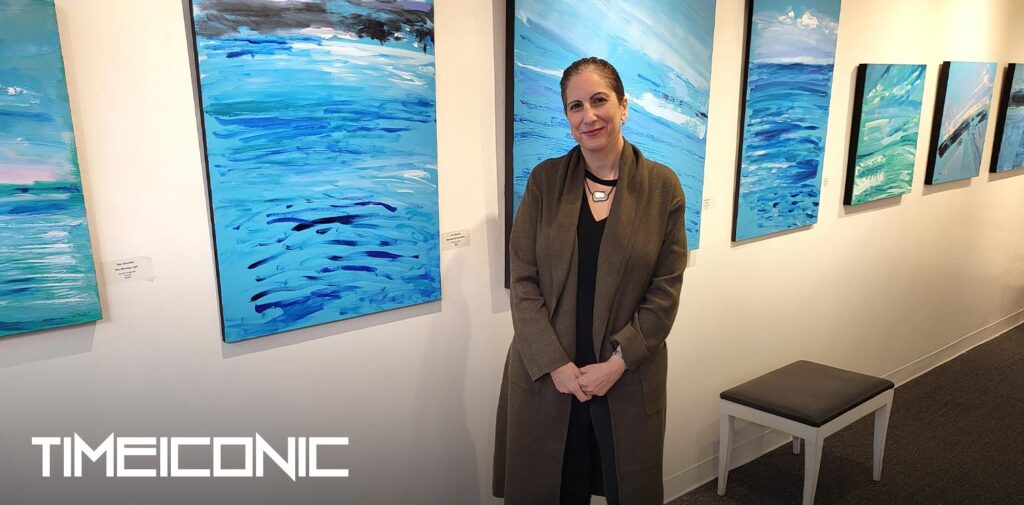
Few contemporary artists describe their own work with as much precision as Vian Borchert. She calls it “visual poetry,” a phrase she coined decades ago to bring the artist and the poet in her into one visible union, and the term has traveled with her through more than 100 exhibitions on several continents. Recently, MSN News named her one of the “Top 10 Women To Watch in 2026,” and Art Market Experts placed her among the most investable artists of 2025 and 2026. Yet the story of how she arrived at this point begins far from any museum wall, in a household where art was simply the way the family spoke.
Borchert’s mother is an artist and her father an art collector, and together they built a childhood saturated with culture. Exhibition openings, lectures and symphony concerts filled the calendar, and artists and writers were welcomed into the family home. “I grew up hearing, talking, and living the arts,” she says, describing an upbringing in which curiosity was not a hobby but an atmosphere. She believes the passion was there from the start, and she speaks of it with gratitude, calling her creative ability a gift she was born with.
That gift did not go unnoticed. Her school principal and teachers encouraged her toward an artistic path, and a scholarship took her to the Corcoran College of Art and Design at George Washington University in Washington, DC, where she is now honored as a Notable Alumni. After her studies she traveled widely and collaborated with international artists on creative projects and group exhibitions, an experience she credits with turning travel into a lasting source of inspiration and meaning for her work.
Back in the United States, she worked at museums including the National Gallery of Fine Arts and the Phillips Collection in Washington. Firsthand exposure to works by master artists gave her a direct education in technique, approach and art history that no classroom could fully replace. Eventually she committed to life as a full-time artist while continuing to teach, a decision that felt less like a detour than a natural extension of her intellectual temperament. Having always loved academia, she saw teaching as a way to “give back to society through teaching and the arts.” That dual commitment to making and sharing has defined her career ever since, and it explains why her reputation rests on far more than the canvas alone.
Painting as Poetry, Poetry as Painting
The phrase “visual poetry” is more than a label for Borchert. It records a lifelong habit. Alongside making art, she has written poetry and imaginative stories since childhood, and she has always loved how imagination can carry a person into other worlds. “I wanted to translate that same sense of wonder into my paintings,” she says. The term was her own invention, a way to make the artist and the poet in her visible in a single gesture.
What poetry offered her was a particular kind of freedom. Words can step back from description while remaining suggestive, intellectual and mysterious, and she wanted her canvases to do the same. Her abstract paintings follow that logic. Rather than naming a place or telling a story, they let the viewer sense space, nature and horizons, along with the relationship between what is visible and what lies beyond it, often invisibly. The result is closer to a stanza than a snapshot, a composition that points toward meaning without pinning it down.
Her route to this language was gradual. She began with figurative art and, through years of creating, learning, meditation and research, moved steadily toward abstracting landscapes, seascapes and skyscapes. An expressionist, painterly approach was present throughout, and she now regards it as “my signature style similar to handwriting.” Nothing about evolution felt forced. Style, in her telling, arrived through experience, reflection and growth, much as a person’s handwriting settles into itself over time.
Emotion is the raw material. Joy and melancholy, the positive and the difficult, all of it gathers in the work. “Each painting becomes a mirror of my soul,” she explains, a record of an inner world of thoughts, fears and aspirations, and of a continuing wish to grow and become a better human being.
Crucially, that mirror is never closed. When people enter a gallery and see her paintings, they receive a glimpse of who she is while bringing their own histories and feelings to the surface. She believes honesty is what makes the exchange possible, because honest work speaks to people on a deeply human level. Interpretation, dialogue and meaningful engagement then grow out of the shared experience, which is the same quiet conversation a good poem invites between writer and reader.
Memory, Nature and the Pull of Light
If poetry gave Borchert her method, nature gave her the subject. Her love of the outdoors began in childhood, shaped by a father who shared it. Every weekend he drove the family into the countryside, where there were picnics, open fields to run through and orchards heavy with blossom and fruit. Those outings planted an early sense that the natural world was a place to be immersed in, not merely observed.
The most vivid memories belong to her grandmother’s garden in Pacific Palisades, Los Angeles, a place now lost to the Palisades fires. She still recalls her grandmother’s pride in it, and a lemon tree whose aromatic leaves she was encouraged to smell. The two would sit together on a balcony overlooking the Pacific Ocean, where her grandmother sang folkloric lullabies about the sun, its warmth and its beauty, and invited the young girl to gaze into the endless blue. The garden is gone, yet the memory remains, and it has become one of the quiet engines of her art.
Borchert suggests that this is where her abstraction begins. With time, she says, such memories turn “blurred, distant, and hazy, much like impressions from a dream.” Her paintings do not illustrate that past so much as carry its traces, evoking a sweet and distant time while holding onto the hope of beautiful times still to come. Seen this way, the soft edges and open horizons in her work are not stylistic habits. They are what remembering actually feels like.
Her present body of work gathers these threads around a single idea: light. She is drawn to the many ways it appears across a day, whether as sunlight, moonlight or the glimmer dancing across rippling water. Beyond its physical beauty, light serves her as a metaphor for hope, clarity and direction, and for the path a person chooses to follow. For her, moving toward the light represents “an aspiration to find meaning, purpose, and a deeper understanding of oneself.”
The idea reaches below the surface of the canvas as well. Borchert describes a deeply personal exploration of the subconscious mind and its bond with creativity, treating art as a bridge between conscious thought and the hidden realm from which imagination rises. She approaches painting “almost as a scientist would,” allowing the process to become a form of investigation and discovery. Through it she looks for the unseen forces, emotions and impulses that shape perception, influence decisions and quietly steer the direction of a life. In this practice, the garden, the ocean and the lullabies meet a larger question about how people find their way toward clarity.
A Global Career, Earned Against the Odds
Borchert’s exhibition record reads like an atlas of the international art world. Across more than 100 group and solo shows, her work has appeared at the Carrousel du Louvre in Paris, the Medinaceli DeArte Museo Contemporáneo in Spain, the SAM Museum in Pennsylvania, the Bank Art Fair in Seoul, the Art3f International Contemporary Art Fair at the Chapiteau de Fontvieille in Monaco, and the AVA Art Festival at the Enokojima Art Centre in Osaka. Closer to home, it has been shown at the World Bank in New York, the Venice Biennale, Art Basel Miami Beach, the Corcoran Museum of Art, the Arts Club of Washington, the Watergate gallery, Strathmore mansion and the 1stDibs Design Center in New York, as well as in embassies and numerous private collections.
The press has followed. Her paintings have appeared in more than 100 publications, among them The Washington Post, Metro Weekly Magazine, World Art News and Museum Week Magazine, and on magazine covers including The Elite Success Magazine. Collectors can find her work on Artsy and 1stDibs, two of the leading online marketplaces, and the recent honors from MSN News and Art Market Experts include a place on the “Top 10 Most Creative Artists in 2025” list, which sits alongside her 2026 recognition as a woman to watch.
The geography has shaped her thinking. Having lived in several parts of the world, including Europe, Borchert calls herself “an international soul” who treats every encounter and every place as a chance to learn. Travel, to her, enriches a person intellectually, emotionally and creatively. At the same time, she holds that art ultimately crosses cultural lines, because the impulse toward it is inherent to being human, whatever a person’s origin.
None of this came without resistance. Borchert is candid that being a woman has made her path harder, adding hurdles, naysayers, bullies and condescension along the way. She has even been told that, were she a male artist, she would be selling at Sotheby’s for millions. “The art world can be a jungle, and it is definitely not for the faint-hearted,” she says. The idea of an excellent woman artist, in her experience, still seems difficult for some people to accept.
What carried her through was a combination of discipline and inner work. She developed a thick skin, stayed steadfast in her approach and kept a clear focus on her goals. When disappointment, rejection or an unkind person knocks her off balance, she turns inward, meditating and reflecting until she has healed. Then she dusts herself off, leaves the weight of the experience behind and moves on toward the light, a phrase that echoes the central metaphor of her current work. Her conclusion is simple and firm: “resilience comes from knowing your worth and not letting others define it for you.”
Teacher, Curator, Thinker
Borchert insists that painting is only one part of who she is. She describes herself as a creator, a thinker, a teacher and a writer, and she sees these roles as intrinsically connected rather than separate careers. Her intellectual reach is formalized in her post as Art Lead for the Oxford Public Philosophy Journal, based at Oxford University in the United Kingdom, where her visual sensibility meets a publication devoted to ideas. She has also worked in art criticism, writing and curation, and has served as an art juror, a role she finds deeply rewarding because it combines the pleasure of selecting and evaluating work with the chance to talk about art with the public.
Teaching, however, has been her most sustained commitment. For two decades she has taught painting and drawing to adults in the Washington, DC area, in venues such as the historic Arts Club of Washington and the Yellow Barn Studio at Glen Echo Park. Her method is patient and structured. She leads students step by step through demonstrations, from drawing and painting to concepts, techniques, philosophies and art history, building a foundation the way a teacher would with children. “You must begin with the ABCs before learning to read and write,” she says, noting that people are perceptive and quick learners when given time, practice and guidance.
Conversation sits at the center of her classroom. She listens to her students’ perspectives and encourages intellectual exchange, an approach she compares to the spirit of Aristotle and Socrates, in which learning unfolds through inquiry, dialogue and discovery. The goal is not only technical skill. It is a wider way of seeing, and a deeper appreciation for the diversity of artistic practice.
That belief explains why she treats looking at art as a skill worth teaching. In her view, helping people see beneath a beautiful surface opens a door into psychology, thought and human emotion. “Art originates in the mind, and the mind is an immense universe with extraordinary depth and infinite possibilities,” she says. As she grows older, she feels a growing responsibility to share that knowledge, and she is convinced that art can elevate society, strengthen self-worth and encourage more thoughtful, compassionate and productive communities.
The same sense of responsibility produced VB Contemporary, where she serves as director and curator. The platform was born from her wish to contribute something better to the art world by approaching it from an artist’s perspective. It is a thoughtfully curated space that supports fellow artists whose work and philosophies align with her own, offering them chances to show their art, share their ideas through interviews and reach a global audience. She describes it as a nurturing place where artists can have “their work seen, their voices heard, and their artistic visions appreciated beyond borders.”
Staying Authentic in a Fast-Moving Market
The contemporary art world is a restless place. Digital platforms reshape how work is discovered, commercial expectations pull artists toward whatever sells, and trends turn over faster than a painter can finish a series. Asked how she balances experimentation with fidelity to her own vision, Borchert answers with disarming brevity. “I simply do me!” she says. For her, that is not a slogan but a principle: art is a form of self-expression, a reflection of the person who makes it.
The answer makes more sense once her relationship to the studio is understood. Art has always been a safe haven for her, a place to retreat into her own world, enter what she playfully calls her Zen zone, and let authenticity flourish. She acknowledges the pressures of a world shaped by technology and commerce, yet she treats her work as something intimate and close to the heart, made by her own hands and guided by her own mind. That personal connection is what she intends to protect. In a culture increasingly driven by speed, she sees lasting value in “keeping art human, personal, and true to oneself.”
This stance does not mean standing still. Her move from figurative art to abstraction, and her current investigation of light and the subconscious, show an artist who keeps evolving. The difference is that each shift comes from inside her own experience and reflection, not from what the market happens to reward. Innovation, in her practice, is a consequence of growth rather than a response to fashion, which may be why her style has remained recognizable across the years.
She offers the same philosophy to the women who are now starting out. Her advice to emerging artists who are trying to find their identities, earn recognition and build sustainable careers is characteristically direct. Be yourself, work hard, stay true to your vision and be patient with yourself, and allow time and experience to guide the way. “Trust the process, and eventually, everything will fall into place,” she says. Given the obstacles she has faced as a woman in the field, the counsel carries weight. It comes from someone who has tested it through rejection and doubt and found that it holds.
What Comes Next
Borchert describes herself as an existentialist, someone who lives primarily in the present moment and believes that what people do today shapes what follows. That outlook keeps her forecasts modest but firm. She recognizes that technology, including artificial intelligence, may play a growing role in how art is made and shared in the years ahead. Even so, she is confident that the human need for expression will not fade, and that art will remain “a sanctuary for authentic, genuine, and deeply personal creativity.” In her view, it is a space where the human spirit can speak freely, however advanced the surrounding tools become.
The near future is already full. This November and December, she will take part in an exhibition and residency at SM Gallery in Georgetown, Washington, DC, a return to the city where she trained, worked in museums and began teaching. Exhibitions are also planned in Europe over the coming year, with details to be announced through her website and social media channels. Her work continues to be available to view and acquire internationally through Artsy and 1stDibs, and her website, vianborchert.com, remains the best place to follow her projects, curatorial activity and upcoming appearances.
When she considers legacy, Borchert thinks first of range. She hopes to be remembered as a multifaceted creator, an inventor of sorts, and “an artist who dared to think beyond conventional boundaries.” Above all she wants to be known for groundbreaking works, paintings that are, in her words, “not merely meant to be seen but truly experienced and enjoyed.” The ambition is as much about the viewer’s inner life as about the object on the wall.
There is also a moral dimension to what she hopes to leave behind. Through her paintings and her philosophical ideas, she aspires to contribute to “a better world, one that is more positive, compassionate, and gentle,” where people treat one another with greater kindness and understanding. It is a quiet ambition, consistent with an artist whose chosen subject is light and whose métier is suggestion rather than argument.
Seen as a whole, Borchert’s career forms a coherent arc. A childhood steeped in culture became a scholarship, a scholarship became museum work and travel, and travel became a worldwide exhibition record, all while teaching, writing and curating kept her connected to the communities around her. What unites the chapters is a conviction she has held since childhood: that art, made honestly and shared generously, can change how people see the world and one another. In an era that rewards speed and spectacle, her patient, luminous paintings make a persuasive case for the opposite.
