
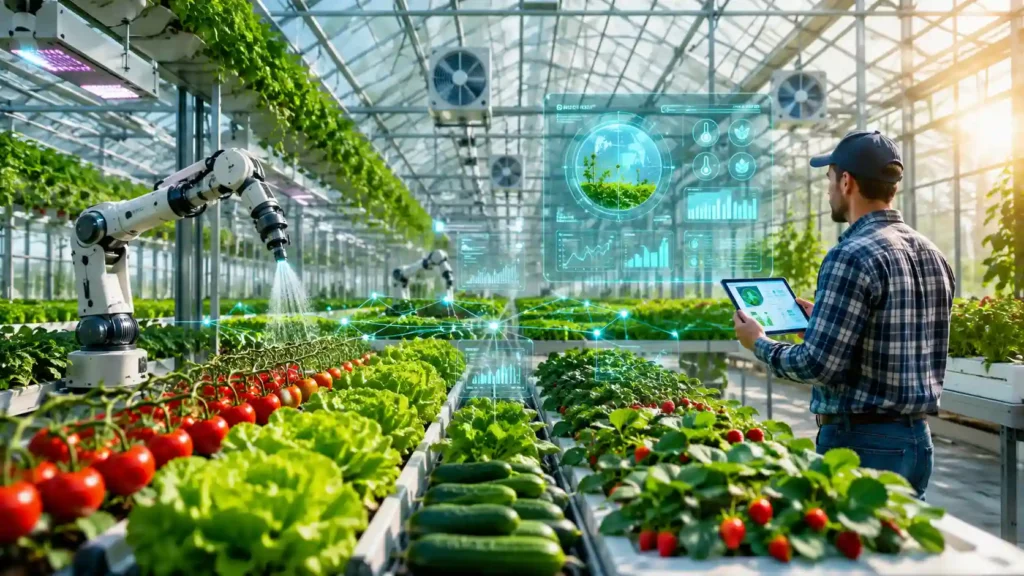
As global food demand continues to rise, smart greenhouse farming is transforming modern agriculture by helping farmers grow more food with fewer resources. Using AI in agriculture, IoT in agriculture, greenhouse automation, precision farming, and climate-controlled greenhouse technology, growers can increase crop yields, reduce water consumption, and improve overall farm efficiency.
Unlike traditional farming, greenhouse farming provides a controlled environment where temperature, humidity, irrigation, lighting, and nutrient levels are automatically managed. This smart farming technology enables year-round crop production while minimizing the impact of climate change, pests, and unpredictable weather. As a result, controlled environment agriculture (CEA) is becoming one of the fastest-growing sectors in the global agriculture industry.
Whether you’re a beginner, a commercial farmer, an agriculture student, or an entrepreneur planning to start a greenhouse farming business, this complete 2026 guide covers everything you need to know about smart greenhouse farming. You’ll learn about the latest technologies, greenhouse setup costs, greenhouse automation systems, the best crops to grow, profitability, and practical tips for building a successful and sustainable farming business.
What Is Smart Greenhouse Farming?
Smart greenhouse farming is a modern agricultural method that uses advanced technologies to automatically monitor and control environmental conditions inside a greenhouse. Unlike traditional greenhouses, smart systems rely on sensors, software, and connected devices to maintain the ideal temperature, humidity, light, irrigation, and carbon dioxide levels for plant growth.
This approach is also known as controlled environment agriculture (CEA) because farmers can create optimal growing conditions regardless of outside weather.
As a result, crops grow faster, healthier, and more consistently while using less water, fertilizer, and energy.
How Smart Greenhouse Technology Works
A smart greenhouse collects real-time information from multiple sensors installed throughout the growing area. These sensors measure important environmental conditions, including:
- Air temperature
- Soil moisture
- Humidity
- Light intensity
- CO₂ concentration
- Water quality
- Nutrient levels
The collected data is analyzed by smart software powered by AI and machine learning. If any parameter moves outside the ideal range, automated systems immediately make adjustments without requiring manual intervention.
For example:
- Irrigation starts automatically when soil becomes dry.
- Cooling fans activate when temperatures become too high.
- Ventilation systems improve airflow when humidity increases.
- LED grow lights switch on when natural sunlight is insufficient.
This automation reduces human error while improving crop quality and production.
Key Technologies Used in Smart Greenhouse Farming
Modern greenhouse farming depends on several advanced technologies working together.
Internet of Things (IoT)
IoT sensors continuously monitor crop conditions and send real-time information to mobile apps or cloud platforms.
Artificial Intelligence (AI)
AI analyzes environmental data and predicts the best growing conditions for each crop. It can even detect early signs of disease before they become visible.
Automated Irrigation Systems
Smart irrigation provides plants with the exact amount of water needed, reducing waste and improving efficiency.
Climate Control Systems
Heating, cooling, ventilation, humidifiers, and dehumidifiers automatically maintain ideal growing conditions throughout the year.
Smart LED Lighting
Energy-efficient LED grow lights provide plants with the correct light spectrum, especially during winter or cloudy seasons.
Remote Monitoring
Farmers can monitor greenhouse conditions from anywhere using smartphones, tablets, or computers.
Benefits of Smart Greenhouse Farming
Smart greenhouse technology offers significant advantages over conventional farming methods.
Higher Crop Yield
Optimized growing conditions help plants develop faster and produce larger harvests.
Year-Round Production
Since environmental conditions are controlled, farmers can grow crops during every season.
Water Conservation
Smart irrigation systems can reduce water consumption by up to 50% compared to traditional farming methods.
Reduced Labor Costs
Automation minimizes manual work, allowing farmers to manage larger growing areas with fewer workers.
Better Crop Quality
Stable environmental conditions improve color, taste, size, and nutritional value.
Lower Disease Risk
Continuous monitoring helps identify plant stress and disease early, reducing crop losses.
Sustainable Agriculture
Smart greenhouse farming supports environmentally friendly food production by reducing chemical use and improving resource efficiency.
Best Crops for Smart Greenhouse Farming
Many high-value crops perform exceptionally well inside smart greenhouses.
Popular greenhouse crops include:
- Tomatoes
- Cucumbers
- Bell peppers
- Lettuce
- Spinach
- Strawberries
- Herbs (Basil, Mint, Coriander)
- Flowers
- Microgreens
- Exotic vegetables
Hydroponic and vertical farming systems are also commonly integrated into smart greenhouses to maximize production.
Smart Greenhouse Setup Cost in 2026
The cost of building a smart greenhouse depends on size, automation level, and equipment quality.
Typical investment includes:
- Greenhouse structure
- Climate control equipment
- IoT sensors
- Automated irrigation
- LED lighting
- Ventilation system
- Monitoring software
- Backup power system
Small greenhouses require lower initial investments, while commercial operations involve higher capital costs but offer greater production capacity and long-term profitability.
Before investing, create a business plan that estimates construction costs, operating expenses, expected yields, and market demand.
Is Smart Greenhouse Farming Profitable?
Yes. Smart greenhouse farming can be highly profitable when managed correctly.
Several factors influence profitability:
- Crop selection
- Market prices
- Energy costs
- Automation efficiency
- Water availability
- Production quality
- Local demand
High-value vegetables, herbs, berries, and specialty crops generally provide the best returns.
Although the initial investment is higher than conventional farming, automation helps reduce labor expenses, increase production efficiency, and minimize crop losses over time.
Many successful greenhouse businesses recover their investment within a few years through consistent production and premium-quality crops.
Challenges of Smart Greenhouse Farming
Despite its advantages, beginners should also understand the challenges.
High Initial Investment
Automation equipment and climate control systems increase startup costs.
Technical Knowledge
Operators need basic knowledge of greenhouse management and smart farming technology.
Electricity Dependence
Most automated systems require a reliable power supply or backup generators.
Regular Maintenance
Sensors, irrigation systems, and climate control equipment require periodic servicing for optimal performance.
Proper planning and training can minimize these challenges.
Future Trends in Smart Greenhouse Farming
The future of greenhouse farming looks increasingly technology-driven.
Key trends expected to shape the industry include:
- AI-powered crop management
- Robotics for harvesting
- Drone-based greenhouse monitoring
- Digital twins for farm simulation
- Renewable energy integration
- Solar-powered greenhouses
- Vertical farming expansion
- Predictive analytics for crop health
- Blockchain-based food traceability
- Fully autonomous greenhouse operations
These innovations will help farmers produce more food while reducing environmental impact.
Tips for Beginners
If you’re starting your first smart greenhouse, follow these best practices:
- Start with a small greenhouse before expanding.
- Choose high-demand, high-value crops.
- Invest in quality automation equipment.
- Monitor greenhouse data regularly.
- Learn basic plant nutrition and disease management.
- Use energy-efficient lighting and irrigation systems.
- Maintain equipment according to manufacturer recommendations.
- Keep detailed production records to improve future performance.
Conclusion
Smart greenhouse farming is transforming agriculture by making food production more efficient, sustainable, and profitable. Through AI, IoT, automation, and climate-controlled growing environments, farmers can increase crop yields while reducing water use, labor costs, and environmental impact.
For beginners entering agriculture in 2026, investing in smart greenhouse technology provides an excellent opportunity to build a modern farming business capable of meeting growing global food demand. While the initial investment may seem significant, the long-term benefits of higher productivity, better crop quality, and year-round cultivation make smart greenhouse farming one of the most promising agricultural innovations of the decade.
Frequently Asked Questions (FAQs)
1. What is smart greenhouse farming?
Smart greenhouse farming uses AI, IoT sensors, automation, and climate control systems to optimize crop growth inside a controlled environment.
2. Is smart greenhouse farming profitable?
Yes. It can generate strong returns by increasing yields, improving crop quality, reducing resource waste, and enabling year-round production.
3. Which crops are best for smart greenhouse farming?
Tomatoes, cucumbers, peppers, lettuce, herbs, strawberries, flowers, microgreens, and leafy vegetables are among the most profitable options.
4. How much does a smart greenhouse cost?
Costs vary depending on greenhouse size, automation level, and equipment. Small systems require modest investment, while commercial operations require significantly more capital.
5. Why is smart greenhouse farming important in 2026?
With climate change, water scarcity, and rising food demand, smart greenhouse farming offers a sustainable way to produce more food using fewer natural resources while improving profitability.
