
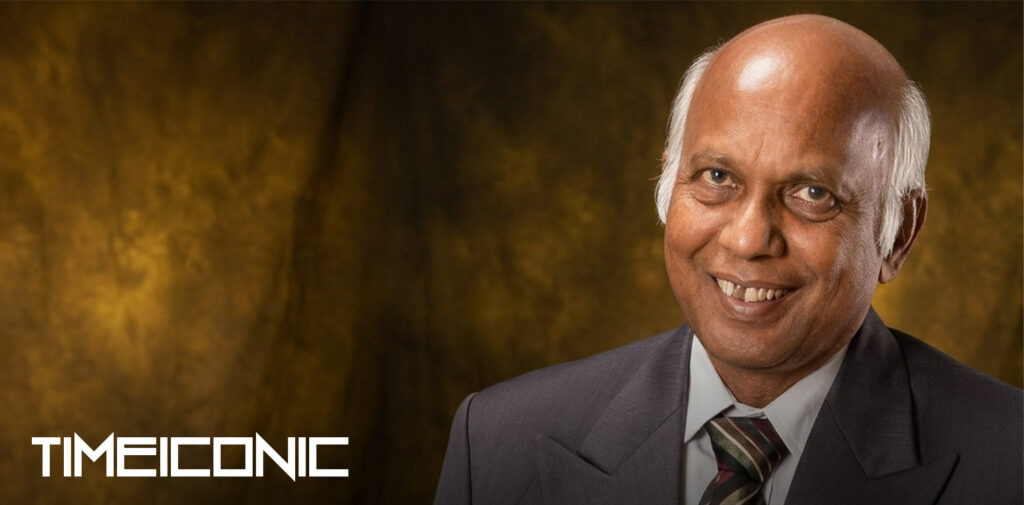
In a business environment where organizations face constant technological disruption, operational complexity, and increasing pressure to deliver results, experienced consultants often become the difference between stagnation and transformation. Few professionals understand this reality better than Murali Chemuturi, Founder of Chemuturi Consultants.
Over a career spanning engineering, information technology, management, consulting, and authorship, Chemuturi has helped organizations navigate change, improve performance, and solve complex business challenges. Through Chemuturi Consultants, he built a reputation for tackling difficult problems, improving operational efficiency, and helping businesses bridge the critical gap between strategy and execution.
His journey reflects more than professional success. It represents a lifelong commitment to continuous learning, practical innovation, and creating value that extends far beyond the boardroom.
Chemuturi began his career as a technical assistant, entering the workforce at a time when opportunities often depended on an individual’s willingness to continuously upgrade their skills.
Rather than treating education as something that ended with formal schooling, he viewed it as a lifelong responsibility. While working full-time, he attended evening classes to strengthen his academic qualifications and broaden his professional capabilities.
Equally important was his commitment to self-learning. He invested his own time and resources in personal development, technical education, and professional growth. Books, journals, and industry publications became an essential part of his routine.
That habit would later prove invaluable as entire industries began undergoing technological change.
“All this happened because of my being involved with what I do and seeing opportunities for improvement in all areas.”
The ability to constantly learn would become one of the defining advantages of his career.
Recognizing Opportunity Before Others Did
When Chemuturi entered the professional world, technology looked very different from what it does today. Electronic calculators were not yet common, and many engineering calculations were performed manually using logarithmic tables and slide rules.
As computers slowly began entering the business environment, many organizations viewed them with uncertainty. Chemuturi saw something different.
Working at Electronics Corporation of India Limited (ECIL), he recognized that emerging computer technologies could significantly improve productivity and simplify business processes. Rather than merely observing the trend, he actively proposed new approaches for applying technology within the organization.
What distinguished his efforts was not simply technological enthusiasm. It was his ability to connect innovation with measurable business outcomes.
With management support, he helped implement computerized systems that improved operational efficiency and delivered tangible organizational benefits. The success of those initiatives expanded both his responsibilities and his professional horizons.
As computers became increasingly important to modern business, Chemuturi found himself at the forefront of that transition.
The rise of information technology fundamentally changed how organizations operated. For many professionals, adapting to those changes proved difficult. For Chemuturi, adaptation became a natural process.
His extensive reading habits enabled him to absorb new technologies quickly and understand emerging systems long before they became mainstream. Manuals, technical documentation, and evolving software tools became opportunities rather than obstacles.
This ability allowed him to play a pioneering role in technology adoption within his organization.
At ECIL, he became one of the earliest advocates for leveraging computers to improve productivity. Those efforts helped establish a benchmark that other organizations would eventually follow.
The significance of this transition extended beyond technical implementation. It demonstrated a broader principle that would shape his entire career: meaningful progress occurs when innovation is aligned with practical business value.
Technology alone was never the objective. Improvement was.
The Evolution of Leadership
As technology transformed organizations, Chemuturi realized that leadership needed to evolve as well.
Traditional management models were often built around supervision, control, and close oversight. However, knowledge-based environments required a different approach. Employees needed guidance, support, and opportunities to develop expertise rather than constant monitoring.
This realization led him to rethink the role of a leader.
Instead of functioning as an overseer, he adopted the role of a coach. His focus shifted toward enabling people to succeed, encouraging ownership, and creating an environment where individuals could grow professionally.
The results became evident over time. Many of the professionals who worked alongside him advanced into senior leadership positions across different parts of the world.
His leadership philosophy was grounded in a simple belief: when people are trusted, supported, and given room to develop, organizations become stronger.
That perspective would later become a cornerstone of his consulting work and broader contributions to management thought.
A New Chapter of Purpose
For many professionals, reaching the pinnacle of a corporate career becomes the ultimate destination. For Murali Chemuturi, it became the beginning of an entirely new journey.
After decades spent navigating engineering, manufacturing, information technology, and organizational leadership, he arrived at a moment of reflection. Having accumulated extensive experience across multiple disciplines, he began asking a different question. Instead of considering what position he could attain next, he wondered what more he was capable of becoming.
That question ultimately led him away from the corporate world and toward entrepreneurship.
When Chemuturi reached the age of fifty, he made a decision that many experienced executives hesitate to make. He left the security of a successful corporate career and established his own consulting practice.
The motivation was not financial. Nor was it driven by dissatisfaction with corporate life.
Instead, it was rooted in a desire to fully realize his potential.
Drawing inspiration from Abraham Maslow’s concept of self-actualization, Chemuturi viewed the transition as an opportunity to test the limits of his knowledge, capabilities, and contribution.
“I wanted to see what I could become.”
That mindset became the foundation of Chemuturi Consultants, a firm created not merely to provide advisory services but to solve meaningful business challenges.
From its earliest days, Chemuturi Consultants developed a distinctive reputation.
Rather than competing in crowded consulting segments or offering generic recommendations, the firm frequently became involved when organizations encountered particularly difficult situations. Clients often approached Chemuturi after traditional approaches had failed or when internal teams struggled to identify a clear path forward.
His value stemmed from perspective.
Leaders immersed in a problem often become constrained by assumptions, organizational politics, or established ways of thinking. Chemuturi’s ability to examine situations from an external viewpoint frequently enabled him to identify solutions that others overlooked.
Throughout his consulting career, he worked with organizations in both India and the United States, helping businesses address operational, technological, and management challenges.
Many assignments involved untangling complex issues that demanded both analytical rigor and practical implementation.
His approach reflected a principle that would guide much of his work: effective consulting is not about impressing clients with expertise. It is about helping them achieve results.
Unlike consultants who stop at recommendations, Chemuturi consistently focused on implementation.
His consulting engagements extended beyond strategic guidance into the development of practical tools and systems that organizations could use to improve performance.
Over the years, he created software solutions supporting project estimation, software engineering, project management, metrics collection, materials requirements planning, and warehouse management.
These solutions emerged directly from real-world business needs rather than theoretical models.
By combining technical expertise with operational understanding, he was able to bridge the gap between strategic objectives and day-to-day execution.
This practical orientation became one of the defining characteristics of his consulting philosophy.
The Human Side of Performance and Leadership
While technology often played a central role in his projects, Chemuturi understood that organizational success ultimately depends on people.
Throughout his career, he encountered the same challenges that confront leaders across industries: competing priorities, communication barriers, resistance to change, hidden agendas, and conflicting interests.
In his view, these human factors are often more difficult to manage than technical problems.
Machines generally behave predictably. People do not.
Rather than relying on authority or rigid control systems, Chemuturi developed leadership practices centered on trust, fairness, transparency, and accountability.
He rejected the traditional “carrot and stick” approach to motivation. Instead, he emphasized objective performance evaluation, open communication, and shared ownership of outcomes.
When team members understood expectations and trusted the evaluation process, engagement increased naturally.
Just as importantly, he believed leaders should share recognition with those responsible for achieving results.
By distributing credit rather than accumulating it, leaders create stronger teams and foster a culture of ownership.
Among the many organizational lessons Chemuturi observed throughout his career, few were more significant than the relationship between strategy and execution.
Many organizations devote enormous effort to developing strategic plans yet struggle to translate those plans into meaningful outcomes. Others focus heavily on execution while neglecting the broader direction required for long-term success.
According to Chemuturi, both approaches are flawed.
Strategy and execution are complementary disciplines that must work together.
“A weak execution renders a great strategy useless, while great execution cannot rescue a weak strategy.”
The organizations that consistently outperform competitors understand this distinction and ensure that both capabilities receive equal attention.
He often compares the relationship to product quality. Exceptional products require both excellent design and excellent workmanship. One cannot replace the other.
Similarly, sustainable business success demands strong strategic thinking combined with disciplined execution.
Organizations that understand this balance are far better positioned to achieve long-term growth.
The Characteristics of High-Performing Organizations
Having advised businesses across industries and geographies, Chemuturi observed recurring patterns among organizations that achieve sustained success.
Trust consistently emerged as one of the most important factors.
Successful organizations cultivate trust between leadership teams, managers, employees, and customers. They create environments where communication flows openly and where individuals understand both organizational objectives and their role in achieving them.
These organizations also excel at placing the right people in the right positions.
Rather than allowing hierarchy or politics to dictate leadership appointments, they prioritize competence, expertise, and alignment with organizational goals.
Fairness plays an equally important role.
Performance measurement, rewards, and advancement opportunities are based on objective criteria rather than subjective preferences. This transparency strengthens credibility and encourages higher levels of engagement throughout the organization.
Most importantly, successful organizations maintain a shared commitment to customer value.
Regardless of industry, geography, or size, the strongest organizations remain focused on delivering meaningful outcomes for those they serve.
Leadership in an Era of Transformation
As technology continues reshaping the business landscape, Chemuturi believes leadership itself is undergoing a significant transformation.
Traditional organizational structures are becoming flatter. Automation is reducing reliance on many routine functions. Artificial intelligence is changing how work is performed across industries.
In this environment, leaders can no longer rely solely on positional authority.
Future leadership, he argues, will increasingly be defined by expertise, adaptability, and the ability to deliver measurable outcomes.
The leaders who remain relevant will be those who actively embrace emerging technologies rather than resist them.
Throughout his own career, every major period of growth came from engaging with change rather than avoiding it. That lesson remains equally relevant today.
“The future belongs to those willing to learn, adapt, and use new tools to create better results.”
Creating More Value Than the Client Pays For
Among the many principles that guided Chemuturi’s consulting career, one stands above the rest.
“I always believed that the value I deliver should exceed what the client pays for.”
This philosophy influenced every assignment he undertook, whether helping organizations improve quality, solve operational challenges, recover struggling projects, or implement new systems.
For him, consulting was never simply a commercial transaction.
It was a commitment to leave clients stronger than they were before the engagement began.
That commitment helped establish credibility, build long-term relationships, and create a body of work that extended far beyond individual projects.
Yet even as his consulting practice grew and his professional influence expanded, another realization began to emerge.
The knowledge accumulated through decades of experience could create impact on a much larger scale if it could be documented, preserved, and shared with future generations.
That realization would eventually transform Murali Chemuturi from a consultant into something else entirely: a producer of knowledge.
From Consultant to Author
Many professionals accumulate expertise over the course of their careers. Far fewer take the time to systematically document that expertise for future generations.
Chemuturi believed that practical knowledge acquired through years of observation, experimentation, success, and failure should not disappear when a career ends.
Driven by that conviction, he began writing.
The process was not an extension of consulting. It was an entirely different challenge. Consulting solves immediate problems. Writing requires converting experience into frameworks, principles, and insights that remain useful across industries and circumstances.
Over time, he authored seven books on information technology and two books on management, creating a substantial body of work that reflects decades of professional learning.
Collectively, those publications encompass approximately 3,500 pages and nearly half a million words.
What began as documentation gradually became a contribution.
The true significance of his books became evident when academic institutions began adopting them for postgraduate study.
Universities across multiple countries incorporated his work into their curricula, recognizing its practical relevance and educational value.
Today, his books have been used as prescribed reading in more than sixty universities across over twenty countries.
For an author whose journey began with self-education and evening classes, the development carries a special significance.
Knowledge that was once acquired through personal effort is now helping educate future generations of professionals.
One milestone proved especially meaningful.
A book on Software Project Management, co-authored with Tom Cagley Jr., was adopted by the IT University of Copenhagen in Denmark. That recognition reinforced his belief that practical industry knowledge could successfully bridge the gap between academia and professional practice.
It also encouraged him to continue writing.
While consulting engagements are limited by geography, organizational boundaries, and time, published work has a far broader reach.
Through authorship, Chemuturi found a way to influence conversations long after projects ended.
His perspective on thought leadership differs from many contemporary interpretations of the term.
For him, thought leadership is not about visibility or personal branding. It is about offering ideas that move beyond conventional thinking and provide meaningful solutions to real problems.
That philosophy shaped both his consulting work and his writing.
Throughout his career, he invested significant effort in studying creative problem-solving methods and analytical techniques that could help organizations overcome complex challenges.
The goal was never innovation for its own sake. It was innovation that created practical value.
This emphasis on usefulness became a defining characteristic of his contributions as an author and advisor.
A Legacy Written in Books
Perhaps the most remarkable aspect of Chemuturi’s publishing journey is the reach his work has achieved.
His books have found places in the collections of some of the world’s most respected institutions.
Libraries associated with universities such as Stanford University and Princeton University house his publications alongside the works of globally recognized scholars and researchers.
Another memorable moment came when he discovered that CERN had included his book on software quality assurance within its library collection.
For an author, such moments represent more than professional recognition.
They symbolize the ability of ideas to travel farther than the individual who created them.
As Chemuturi himself reflects, his books reached places he may never personally visit.
Over the course of his career, Chemuturi’s contributions to industrial engineering, software measurement, information technology, and management have been recognized through numerous honors.
Among the most significant was his elevation as a Fellow of the Indian Institution of Industrial Engineering, reflecting the respect he earned within the profession.
His innovative work applying industrial engineering principles to software measurement also earned him the prestigious Lillian Gilbreth Award for Outstanding Industrial Engineer.
Recognition extended into the technology sector as well. The Computer Society of India honored him with its Hall of Fame Award for contributions to information technology.
Additional accolades, including a Lifetime Achievement Award from the Asian Leadership Awards, further acknowledged the breadth of his impact across multiple disciplines.
Yet despite these achievements, his reflections consistently return to contribution rather than recognition.
Awards celebrate accomplishments. Impact is measured by what remains useful after the applause ends.
Giving Back and Preserving Wisdom
Throughout his journey, Chemuturi sought to create impact beyond the professional sphere. His contributions have included supporting educational institutions, donating books to school libraries, funding infrastructure improvements in schools, and establishing awards that encourage excellence among industrial engineers and young researchers. These initiatives reflect his belief that professional success carries a responsibility to support future generations and create opportunities for others to learn and grow.
Even after decades of accomplishment, Chemuturi continues to pursue new intellectual challenges. Having extensively documented his expertise in technology and management, he turned his attention toward ancient wisdom and spiritual literature. Through the translation of classical Sanskrit texts, including the Ramayana, Bhagavad Gita, Garuda Purana, Shanthi Parva, Anushaashana Parva and Ashwamedha Parva of Maha Bhaarath, he has worked to make these works accessible to a wider audience. For him, the effort is not simply about translation but about preserving and sharing knowledge so that it remains available to future generations.
Underlying these endeavors is the same set of values that shaped every stage of his career: honesty, sincerity, hard work, continuous learning, and resilience.
One principle in particular became a lifelong guide: “Do it well or not at all.”
Whether implementing technology, delivering consulting assignments, authoring books, or contributing to society, Chemuturi consistently pursued excellence with integrity. The transition from software engineering to ancient literature may seem unexpected, yet it reflects the same curiosity, discipline, and commitment to learning that have defined his remarkable journey.
A Legacy Defined by Knowledge
Murali Chemuturi’s story is not simply the story of a consultant, technologist, or author.
It is the story of continuous reinvention.
From engineering and manufacturing to information technology, from consulting to authorship, and from modern management practices to the translation of ancient wisdom, each phase of his journey has been connected by an unwavering commitment to learning and contribution.
His legacy is not limited to organizations advised or projects completed. It lives in classrooms where students study his books, in professionals who apply lessons drawn from his work, and in readers who continue discovering ideas he chose to document rather than keep to himself.
In an era defined by rapid change, Murali Chemuturi’s career offers a timeless reminder that lasting influence is built not merely through success, but through the knowledge, values, and opportunities one leaves behind for others.
“Success is temporary. Knowledge shared becomes legacy.”
