
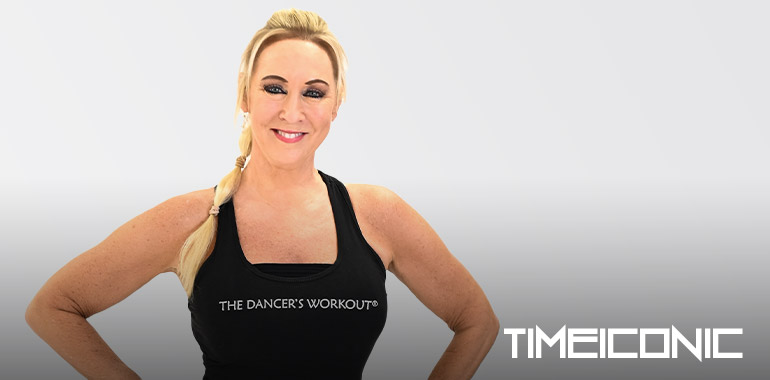
Long before The Dancer’s Workout® became a defining name in adult dance fitness, its founder, Jules Szabo, was already living two distinct yet deeply connected professional lives.
Her journey did not follow a straight line. Instead, it unfolded across two demanding worlds that would ultimately shape one another in unexpected ways: the disciplined intensity of professional dance training and the structured rigor of a decades-long corporate career.
As a teenager, Jules trained at the University of North Carolina School of the Arts (UNCSA), where she majored in classical ballet. These High School years were not simply about mastering her dance technique. They were about developing a strong, resilient mindset.
“My UNCSA experience established, on a fundamental level, who I am as a person,” she reflects.
The environment demanded more than physical excellence. It required discipline, tenacity, teamwork, and the ability to withstand intense critique. What emerged from this experience was a foundation that extended far beyond the studio. It shaped how she approached challenges, processed feedback, and pursued excellence, skills needed not only for a professional career in dance but also for a successful corporate career.
Seeing the possibilities, Jules spent the next four years completing her undergraduate degree and then set sail on a wild corporate adventure.
A Corporate Climb Built on Artistic Foundations
After her early training, Jules began working in the pharmaceutical industry, beginning in an entry-level position and steadily rising through the ranks over 32 years.
Her ascent was anything but accidental.
From secretary in a medical office to Vice President of Global Clinical Trial Operations, she navigated increasingly complex roles that required leadership, strategic thinking, and operational precision. Along the way, she built expertise in project management, business development, and organizational leadership.
What is striking, however, is not just the trajectory, but the connection between her two worlds.
The same discipline that defined her dance training became the engine behind her corporate success.
“I’m not sure I would have become very successful in either career had I not experienced them both,” she says.
Her artistic background trained her to think creatively under pressure, while her corporate career refined her ability to execute ideas with structure and scale. Together, they formed a rare combination of creativity and operational strength.
Still, a piece of her was missing.
The Quiet Absence of Dance
For fifteen years, Jules did not dance.
During that time, she built a successful career, raised a family, and achieved milestones that many would consider fulfilling. Yet beneath the surface, there remained an unspoken void.
No professional achievement could replace what dance had once provided.
There was, as she describes it, an “underlying sense of loss” that never fully went away.
This absence was not dramatic or disruptive. It was quiet, persistent, and deeply personal. A reminder that certain parts of one’s identity cannot simply be replaced by success in other areas.
As the years passed, that feeling remained, subtle but undeniable. And eventually, circumstances began to shift.
By her early forties, Jules had achieved stability both personally and professionally. Her family was established, her career had reached a senior level, and for the first time in years, space began to open up.
What stood in her way was no longer time.
It was fear.
The idea of returning to dance brought with it a flood of emotions. Vulnerability, self-doubt, and the weight of years spent away from something that once defined her.
The turning point came unexpectedly, during a simple conversation when Jules finally admitted that she wanted to dance again but was afraid she would cry in the studio if she tried. The response stayed with her:
“So what? At least you’d be dancing.”
That single moment cut through years of hesitation. It reframed the fear, not as a barrier, but as part of the process.
Soon after, Jules made a decision that would redefine her future. She enrolled in adult dance classes and stepped back into a world she had left behind for over a decade.
“At 41 years old and 30 pounds overweight, it was finally time to come home,” she says.
It was not a return to who she once was. It was the beginning of becoming someone new.
Searching for Something That Didn’t Exist
Returning to dance was not the resolution Jules had imagined. It was, instead, the beginning of another challenge.
Determined to rebuild her connection with dance, she immersed herself fully! Adult ballet classes, jazz classes, gym programs, boutique fitness solutions, anything that came close to the rhythm and structure she once knew. Her commitment was intense. While still working full-time in a demanding corporate role, she set a personal goal to dance five to six times a week.
For six years, she maintained that pace.
Her schedule was relentless, often traveling across multiple cities just to piece together a week of classes that felt somewhat aligned with her needs. Progress came slowly but steadily. She regained strength, lost weight, and eventually began to recognize herself again.
But something was fundamentally wrong.
The options available to adult dancers felt incomplete. Adult beginner classes moved too slowly and lacked the technical depth and energy that former dancers craved. Intermediate and advanced classes, on the other hand, presented a different kind of problem. They were frequently dominated by teenage dancers, with choreography designed for bodies that had never stepped away from training.
“I was frustrated by how elementary the beginner classes were and by how athletically dangerous the intermediate and advanced classes felt,” she recalls.
What she needed did not exist and that realization became the foundation of something much bigger.
Recognizing a Hidden DEMOGRAPHIC
The insight did not come from data at first. It came from instinct.
Jules knew she was not alone. The emotional and physical experience she was navigating felt too universal to be isolated. There had to be others who felt the same way, former dancers who had stepped away from their training and built lives in other directions, who were now quietly carrying the same desperate sense of disconnection.
Later, research would reinforce this intuition.
Studies suggested that millions of young dancers had trained in studios and academic programs across the United States over the years. Many of them had since grown into adulthood, leaving behind structured dance environments with few opportunities to return in a meaningful way.
What existed was an identity gap in both the fitness and dance ecosystems, where an entire community had been overlooked and underserved.
A generation of dancers who did not need to be introduced to dance basics, but who, instead, needed a safe, structured, and inspiring way to return to dance.
“They would return,” she believed, “if the classes were designed for them.”
The Birth of a Concept
The idea that would evolve into The Dancer’s Workout® was not built overnight. It evolved from lived experience, frustration, and a deep understanding of both dance and discipline.
Jules envisioned something very specific.
A high-energy dance fitness class rooted in classical technique, yet adapted for adult bodies. A program that combined intermediate-level ballet, jazz, and contemporary dance with conditioning exercises, all choreographed to modern music.
But beyond the physical design, there was a deeper intention.It had to feel safe. Not just physically, but emotionally.
For many former dancers, returning to the studio meant confronting self-doubt, comparison, and the fear of no longer being who they once were. Jules understood this intimately. She had lived it. What she began to create was not just a series of classes, but a safe, systemized pathway back to dance for adult former dancers.
A Deeply Personal Life Mission Begins
Looking back, Jules explains that her entire life mission soon became crystal clear. From this point on, she would fully dedicate herself to helping other adult former dancers start dancing again.
Her confidence about this wasn’t loud or performative. It was, simply, persistent and unwavering. Everything in her past had led her to this moment, including the roots that traced back to her upbringing.
Her father, a banker and former athlete, instilled in her a strong sense of practicality and business awareness. Her mother, a professional opera singer and educator, embodied creativity, ambition, and artistic courage.
Between those two influences, Jules developed a rare balance. She had learned how to think like an operator, but also how to dream without limitation.
“I’ve often wondered why it never even occurred to me that I couldn’t do it,” she says.
That confident mindset would prove critical in the years ahead, as identifying a gap is one thing, but actually building something to fill it is another.
The First Steps Toward Creation
What began as an idea slowly turned into action.
Jules started choreographing her own classes, drawing from the various disciplines she had experienced over the years. Ballet, jazz, contemporary dance, Pilates, yoga, and even her earlier experience teaching aerobics began to merge into a single, cohesive format.
One lesson, in particular, shaped the structure of her program.
Early in her teaching journey, she was told something simple but transformative: keep students moving.
Instead of stopping to explain choreography in segments, the class should flow continuously. Movement should build naturally, allowing participants to learn by doing rather than pausing.
This principle became central to her method.
She designed a 60-minute format that starts with a 10-minute choreography explanation and then proceeds into continuous warm-up and low-impact, intermediate-level ballet, jazz, and contemporary dance cardio sequences that build upon themselves as the songs progress. She adds 15 minutes of choreographed conditioning exercises to the end of each class. These one-hour classes are perceived by trained dancers as fully immersive total body workouts that use the precise types of dance movements they are trained to execute.
The classes are efficient, dynamic, and engaging. Additionally, they are offered at times that respect the time and availability of adult participants.
Nothing Comes Easy
For Jules, like most entrepreneurs, the reality of turning an idea into something tangible began slowly. Those early days of The Dancer’s Workout® were marked by hard work, determination, tenacity, and quiet persistence.
As an example, in 2009, Jules was hired to teach at an adult dance studio. In preparation for this, she invested nearly 80 hours into choreographing and refining her first official class of The Dancer’s Workout®. As the date approached, she was ready! She stepped into the studio with excited anticipation…
And no one showed up.
It was a moment that could have easily defined the outcome. Many ideas never move beyond this stage, where effort meets silence and momentum feels distant.
But Jules approached it differently. She returned to teach the following week. And the next. And the next.
Gradually, a few participants began to attend. What mattered more than the numbers was their consistency. Those early students came back, not out of obligation, but because they felt something distinct in the experience.
Among them were individuals who would go on to become long-term members of the community. Their commitment signaled that the concept, though still in its infancy, held real value.
Momentum did not arrive suddenly, but built consistently over time through repetition and word of mouth. Former dancers who found the program became die-hard participants; and the word about this one-of-a-kind class began spreading through inner circles.
What started as an empty room began to feel like the early formation of something meaningful.
The Challenges of Building from Scratch
As the program began to gain traction, the challenges became more defined and more complex.
Jules’ journey into entrepreneurship required her to operate across multiple dimensions simultaneously, each demanding a different set of skills.
Product development remained a consistent priority. She would teach the same choreography for four to eight weeks to enable her students to progressively learn, practice, and ultimately embody the choreography before progressing to a new masterclass. At the end of each choreography cycle, she would roll out a completely new masterclass for them to tackle. Naming each 60-minute set of choreography along the way, she built an exciting and effective portfolio of masterclasses.
Student recruitment presented a different challenge.
The audience she was trying to reach, adult former dancers, was inherently hesitant. Many carried self-doubt about returning, making it difficult to attract them initially. Reassurance, through word of mouth from existing students, was key, as was the specific messaging used to promote the brand. Once the newcomer joined the class, they immediately became a loyal participant, a pattern that contributed to the program’s high student retention power.
Time management became a pressing issue.
At this stage, Jules was balancing a senior corporate leadership role, raising three teenagers, and growing her dance fitness program simultaneously. Her days extended into evenings and weekends, where she continued to teach, choreograph, and build the business.
Then there was the matter of intellectual property.
As the program began to take shape, protecting it became essential. The name, the structure, and the methodology all represented years of thought and effort. Ensuring that it could be secured and expanded without compromise became a strategic priority.
Each of these challenges tested a different aspect of her capability.
Together, they defined the reality of building something from the ground up.
The Leap into Full-Time Entrepreneurship
After years of balancing dual careers, a defining moment arrived.
In December 2014, Jules made the decision to step away from her 32-year career in the pharmaceutical industry and commit fully to her dance fitness business.
It was not a spontaneous decision.
The idea had been forming over time, shaped by the growing traction of her program and the increasing realization that its potential extended far beyond what she could manage on the side.
Leaving behind a stable, high-level position required both clarity and courage.
For Jules, the decision was supported by a strong personal foundation. Her husband played a significant role, providing the support and stability needed to take such a step. Around this time, one of her adult students, Sara, joined the program and expressed interest in helping Jules take the program to the next level.
With her attention no longer divided, and a brilliant dancer, tactician, and friend by her side, the business began to evolve more rapidly.
She now had the time to refine the program, expand its reach, and begin to build its long-term future.
“IT WAS TIME TO RISE,” she reflects.
This transition marked a turning point.
What had once been a passion project now became a fully realized entrepreneurial pursuit.
Protecting and Structuring the Brand
As The Dancer’s Workout® continued to grow, Jules recognized the importance of formalizing what she had built.
The name, which she had been using in the marketplace since 2009, was officially approved as a registered trademark in 2015. This step was critical in protecting the brand and securing its position for long-term growth.
Trademark protection provided more than legal security. It provided branding consistency. From marketing materials to future digital platforms, every aspect of the brand could now be aligned under a unified identity.
With both trademark protection and the program structure in place, Jules was excited to begin expanding her program beyond the various local dance studios, gyms, art centers, and apartment complex fitness facilities that had allowed her to successfully pilot and refine the program. Now she wanted to reach and inspire dancers via the virtual marketplace and wondered if her program would translate virtually.
Culture and the Power of Community
While the structure of the program was essential, its long-term success was equally dependent on something less tangible.
CULTURE
Jules’ leadership style, shaped during her corporate career, became a defining element of the experience she created.
Early in her management journey, she participated in a prolonged leadership training program that focused on emotional intelligence, large group facilitation, and community building. Those lessons remained with her, influencing how she approached leadership in every setting.
When applied to her adult dance fitness program, they permeated and solidified the culture.
Classes were no longer just instructional sessions. They became shared experiences, where participants felt connected, supported, and valued.
Over time, Jules came to a clear understanding.
An excellent class without a compelling student culture would likely not sustain enrollment. Likewise, a compelling student culture without an exceptional class would likely not sustain enrollment.
“THE MAGIC IS IN THE COMBINATION.”
This combination became one of the founding principles of The Dancer’s Workout®.
Participants did not return just for the choreography and the opportunity to practice and refine their movements throughout the choreography cycles. They returned for the camaraderie, made possible by the shared experiences of doing so together, coupled with the friendships they formed before and after classes.
Every new dancer entered with a similar story, returning after years away, often carrying hesitation. Those who had already navigated that journey naturally supported newcomers, creating a cycle of encouragement that strengthened the community over time.
This dynamic allowed the program to grow beyond its founder.
It became self-sustaining.
Participants formed connections that extended beyond the class, building relationships rooted in shared experience and mutual support.
In this environment, movement was only part of the story. Belonging became just as important.
A Return to Identity
What began as a structured solution for adult dancers gradually revealed itself as something far more profound.
For Jules and her growing team at The Dancer’s Workout®, the most powerful outcomes were not measured in repetitions, performances, or bench presses.
They were measured in transformations.
Over the years, thousands of her students have returned to dance through the program. The physical changes are visible. Weight loss, increased strength, improved flexibility, and restored technique.
But the deeper shifts are less visible and far more significant.
Participants rediscover confidence. They reconnect with a part of themselves that had long been set aside. They rebuild not only their physical shape and wellness, but their literal sense of identity.
The Emotional Architecture of the Program
Part of what makes The Dancer’s Workout® effective is its intentional structure.
Each masterclass is carefully designed, not only to challenge the body, but to guide participants through a progressive and achievable experience. The choreography builds step by step, allowing dancers to regain familiarity and confidence over time.
The program blends technique, fitness, and emotional connection into a single experience.
Students often describe different elements as the “secret” behind its impact. Some point to the choreography. Others highlight the friendships they build. Many speak about the joy of simply belonging to a group again.
In reality, it is the combination of all these factors.
It is a system where physical movement, social connection, and emotional fulfillment intersect.
A Safe Path Back to Dance
One of the defining principles of the program is accessibility.
Jules understood early on that returning to dance as an adult can feel overwhelming. The physical demands, combined with emotional hesitation, create barriers that many struggle to overcome.
To address this, the program offers multiple entry points.
For those who prefer privacy and gradual progression, a structured virtual pathway allows participants to rebuild strength and confidence in the privacy of their own homes. For others, group classes – taught live and via virtual instruction – provide an immersive, community-driven experience in a studio environment.
Both approaches are built on the same philosophy that re-entry into dance should be progressive and should feel achievable. Growth should feel safe.
This dual model has allowed the brand to extend its reach beyond a single location, making it accessible to a broader audience.
Sharing The Love
As demand grew, so did the technology used to reach the broader community of dancers.
Over time, with the help of her local students, Jules filmed her growing portfolio of masterclasses. The development of a digital platform enabled The Dancer’s Workout®to expand beyond her local studio through business-to-consumer, on-demand programs for former dancers.
Prior to the pandemic, early recordings of these virtual classes were also featured on Fitness On Demand and made available to thousands of gyms and fitness facilities throughout the United States. After the pandemic, once in-person classes resumed, Jules founded The Dancer’s Workout® MAVENS to help her film all of her newly created masterclasses.
The team was thrilled when one of her virtual programs, the “21-Day Dancer Restarter Wizard,” received a Good Housekeeping 2023 Fitness Award in the Top Wellness App category of “Best for Former Dancers.” The 10-video series, which enables former dancers to gradually return to dance in the privacy of their homes, remains available inside “The Dancer’s Workout® Virtual Studio,” her subscription-based app where dancers who prefer to train from home can access the growing library of masterclasses created by Jules and The Dancer’s Workout® MAVENS.
At the same time, the introduction of her instructor training and certification program created new opportunities for expansion. Through this immersive online course, seasoned dancers from across the country can become certified instructors who offer The Dancer’s Workout® classes in their own communities, thereby providing other adults the opportunity to return to dance in an in-person setting.
By expanding the program’s footprint, Jules continues working toward her life mission of inspiring former dancers to dance again.
The Ultimate Pressure Test
One might say that inspiring adult former dancers is one thing; but inspiring top-level, pre-professional dancers is quite another.
In Fall 2024, Jules was invited to join the faculty of the UNC School of the Arts, School of Dance, as an Adjunct Faculty member. What began as a series of meetings regarding her Instructor Certification program turned into an opportunity for Jules to teach weekly conditioning classes for the school’s classical ballet and contemporary dance students.
For Jules, returning to her alma mater to teach her brainchild represented the ultimate litmus test, especially given UNCSA’s ranking as one of the nation’s premier conservatories for ballet and contemporary dance. Going into it, she was both excited and curious to see whether such exceedingly talented, dedicated, and highly discerning students would love The Dancer’s Workout® the way her adult dancers do.
And they did!
Throughout the 2024–2025 academic year, Jules taught weekly classes of The Dancer’s Workout® to UNCSA high school ballet students and undergraduate contemporary dance majors. During her weekly classes, the energy in the studio was undeniable! The dancers cheered, sang along, and were encouraged to add sophisticated artistic embellishments as their familiarity with each masterclass deepened.
They appeared to love the structure of the masterclasses and the way the choreography gradually unfolded throughout each 4-week masterclass cycle. As additional conditioning and cardio songs were layered into the classes each week, the dancers quickly absorbed the material, improved their performance, and fully embraced the experience.
The Dancer’s Workout® classes became recognized not only as a conditioning experience, but also as an artistic and high-energy training process that challenged dancers to build endurance, stamina, musicality, and their ability to rapidly consume and perform choreography with confidence and joyful stage presence. Following the success of her initial year, Jules was invited back to teach during subsequent UNCSA academic years and summer programs — a powerful testimony to the program’s ability to inspire and benefit this broader range of dancers as well.
BUCKLE UP, BUTTERCUP!
Having successfully pressure-tested The Dancer’s Workout® with thousands of adult former dancers and hundreds of conservatory-trained dance students, a new vision emerged. One that provides adult dancers, who are categorically underserved in conventional fitness settings, both a scalable, return-to-dance pathway and an endless supply of “fully vetted, teddy-bear-hugged-and-loved, repeatable dance-fitness masterclasses” that can be enjoyed inside numerous cutting-edge health clubs and fitness facilities which include virtually-led classes on their schedules.
“The Dancer’s Workout® Virtual Studio System” was developed as the first scalable, studio-in-a-box, virtual instruction system specifically designed to bring professionally filmed dance fitness masterclasses into gyms, fitness facilities, and other wellness environments already equipped for virtual programming. Jules and Sara designed the turnkey system to integrate seamlessly into existing schedules and studio spaces, so that trained dancers throughout the country could enjoy these masterclasses in a group setting.
The Dancer’s Workout® virtually-led, in-person classes provide something that adult, former dancers have been missing for years: community. Through these in-person studio experiences, dancers not only reconnect with their love of dance, but also with the friendships, discipline, artistry, and shared identity that once defined them. Their loyalty to the program is testimony to the impact that dance plays in their lives, even as adults.
The Legacy
Today, Jules’ work represents far more than a fitness program or dance class. Through her masterclasses, instructor certification program, digital platforms, and expanding virtual studio system, she is building a lasting framework designed to help trained dancers reconnect with dance throughout every stage of life.
What began with her personal journey as an adult former dancer has evolved into a growing network of students, instructors, faculty colleagues, and business partners, all united by a shared appreciation for the important role dance plays in our lives.
