
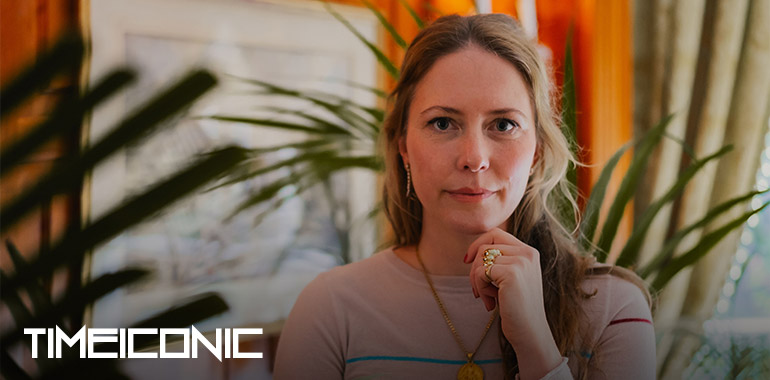
There are leaders who teach strategy. There are innovators who teach frameworks. And then there are those rare individuals who fundamentally shift the way leadership itself is understood.
Hedi Schaefer belongs to the latter category.
Today, as the founder of The Impact Boutique, she is known globally for integrating neuroscience, identity work, and innovation methodology into a transformation ecosystem that challenges the traditional leadership paradigm. But her path toward conscious leadership did not begin in a boardroom. It began in the intensity of the arts.
The Burnout That Became a Beginning
Long before she became a transformation architect, Hedi immersed herself in the creative world. She worked alongside renowned figures such as Herbert Grönemeyer and Christoph Schlingensief, and contributed to internationally respected platforms like the Salzburg Festival.
Driven by curiosity and ambition, she wanted to master everything. Every art form. Every process. Every layer behind the scenes.
By the age of twenty-five, that hunger for excellence came at a cost.
“I had poured my energy into projects and people without a break,” she reflects. “The sheer intensity left me completely exhausted.”
What appeared externally as success felt internally like depletion. The pace was relentless. The identity was externally defined. And eventually, her nervous system could no longer sustain it. That collapse became her catalyst.
In a radical decision that would redefine her life, she left everything behind. Her profession. Her apartment. Her relationship. She moved alone to South Korea for fourteen months. For the first time in years, she experienced stillness.
“My nervous system felt grounded. I felt myself. Confident. Present. Alive.”
That experience planted a seed. One that would later become her life’s work.
Innovation Without Inner Readiness
Upon returning to Europe, Hedi entered the world of corporate innovation. As part of Germany’s first generation of Design Thinking consultants, she worked globally with Fortune 500 companies and NGOs, facilitating transformation initiatives and large-scale strategic shifts. It was here that she observed a recurring and deeply troubling pattern. Brilliant strategies failed.
Not because they were poorly designed. Not because they lacked resources. But because the people leading them were not internally prepared for change.
“We were practicing human-centered design for products and systems,” she explains. “But we were completely neglecting the human system within.”
She saw leaders blocked by fear, ego-driven reasoning, and limiting beliefs. The resistance was rarely intellectual. It was biological. Emotional. Identity-based.
One pivotal example stood out. A senior leader at Volkswagen, Dirk Weimann, demonstrated what she later described as a “no matter what” attitude. He stripped down his office, rebuilt the space with his team, and endured rumors that he had been removed from his position, simply to enable a new way of working. That courage revealed something essential.
Leadership transformation requires identity transformation. Around the same time, a quote often attributed to Albert Einstein crystallized her thinking: “You cannot solve a problem with the same consciousness that created it.”
The insight became foundational to her philosophy. External tools alone were insufficient. Without inner evolution, innovation remained fragile.
Motherhood and the Identity Crisis
Despite her growing expertise, Hedi herself continued operating at high speed. Years of nonstop work, travel, and responsibility eventually resurfaced the same exhaustion she had experienced in her twenties. Then she became a mother. The shift was seismic.
The pace that once defined her success no longer aligned with the presence her child required. For the first time, external achievements felt hollow. She confronted an internal voice she had long ignored. Not good enough. Not ready. Not enough. Walking along the river with her baby resting against her chest, a quiet but life-altering question emerged.
“What if I lived fully. Not through my work, but through who I am.”
That question did not seek more productivity. It sought authenticity. It marked the beginning of her deepest transformation. She realized that high performance without inner alignment creates dissonance. And dissonance eventually manifests as burnout.
“You cannot pour from an empty cup,” she says. “But you can pour from an overflow. And that creates extraordinary results.”
This principle would later define her methodology.
The Internal Gap in Leadership Development
Through her corporate work and personal reckoning, Hedi recognized a fundamental gap in the leadership development industry. Most programs focused on strategy, KPIs, and productivity frameworks. They assumed that equipping leaders with tools would naturally lead to sustainable success. But tools do not override subconscious programming. Many high achievers were operating from survival beliefs formed in early childhood. Life is hard. Prove yourself to be valuable. Keep it together alone. Be perfect.
These narratives fuel performance. They also fuel burnout.
“The root cause is our survival program,” she explains. “When actions, words, and feelings are misaligned, energy drains and performance suffers.”
Hedi saw leaders driven by external validation while ignoring their internal compass. Over time, their nervous systems signaled distress. But the signals were overridden. Burnout, in her view, is not weakness. It is a biological response to prolonged misalignment.
The Birth of The Impact Boutique
In response to this gap, Hedi founded The Impact Boutique. Not as a traditional coaching platform, but as a curated transformation ecosystem.
Its foundation rests on what she calls the 3Cs of Change.
Clarity. Cleanse. Create.
Clarity begins with defining purpose, vision, values, and leadership identity. It addresses a crucial question most leaders never fully explore. Who am I beyond performance? Cleanse focuses on subconscious reprogramming. It involves identifying and releasing limiting beliefs, generational conditioning, and internal sabotage patterns. Create then channels this aligned identity into tangible innovation, agile tools, and strategic execution.
“Outer success is the byproduct of deep inner work,” Hedi explains. “Without inner capabilities, external accomplishments remain fragile.”
Unlike conventional productivity systems, her approach begins with identity. Leaders are not trained to do more. They are guided to become someone different. The name “Boutique” reflects intention. High-touch. Curated. Designed with care. Free from noise and overwhelm. Early participants included mothers returning to high performance and executives navigating identity crises. They were not seeking motivation. They were seeking integration.
And the results were measurable.
Leaders reported moving from reactive survival energy to calm authority. From victim mode to creator mindset. From burnout to magnetic presence.
One participant described the shift this way:
“I am no longer stuck in victim mode but live in complete power. Instead of constantly pushing under pressure, I know I can.”
Another reflected:
“This is not coaching. It is a profound experience for people committed with heart and brain to themselves and the vision of a better world.”
Transformation, in her ecosystem, is not temporary motivation. It is neurological rewiring.
From Intellectual Insight to Embodied Leadership
One of the most persistent illusions in corporate leadership is the belief that understanding change intellectually is enough to execute it successfully.
Hedi disagrees.
“Knowing something is not the same as living it,” she explains. “Sustainable transformation is embodiment. It is moving from ‘I know this’ to ‘I am this and act as this.’”
This distinction sits at the core of her methodology.
In fast-paced environments, leaders often accumulate frameworks, certifications, and strategic tools. They attend workshops. They understand innovation cycles. They can articulate transformation strategies with precision. Yet when pressure rises, they default to old patterns.
Why?
Because the subconscious identity has not shifted.
Through the 3Cs of Change framework, Hedi guides leaders beyond cognitive awareness. Clarity offers direction. Cleanse addresses subconscious blocks in a relaxed and aware state, allowing leaders to release limiting beliefs and integrate new neural patterns. Create then translates this upgraded identity into action.
Neuroscience supports this process. When identity shifts at the subconscious level, neural pathways reorganize to sustain new behaviors. Confidence becomes natural rather than forced. Resilience becomes embodied rather than rehearsed. The visible transformation is striking. Leaders move from reactive tension to grounded presence. From hesitation to aligned authority. From constant overexertion to focused momentum.
“The shift often feels uncomfortable at first,” she notes. “You are rehearsing a self you have never been before. But once it integrates, it becomes effortless and permanent.”
In this process, leadership ceases to be performance. It becomes a state of being.
Redefining Emotional Intelligence for a New Era
Modern leadership increasingly demands emotional intelligence, yet Hedi believes the concept itself is evolving.
Traditional emotional intelligence focuses on awareness of feelings and social dynamics. The next evolution, she argues, involves actively upgrading internal patterns.
“Emotional intelligence is awareness of your internal state and understanding how it influences your environment. The new emotional intelligence is knowing you can release those triggers and rewire your internal state.”
This is where resilience emerges.
For Hedi, resilience is not endurance. It is the capacity to navigate uncertainty from a regulated nervous system. Leaders who operate from inner authority do not suppress emotions. They integrate them. When subconscious triggers are addressed, projection decreases. Reactivity softens. Decisions become less defensive and more strategic. Authenticity, in this context, is not a branding strategy. It is the byproduct of internal alignment.
“When leaders stop performing power and start embodying it, authenticity emerges naturally.”
This has tangible consequences within organizations. Teams sense coherence. Psychological safety increases. Boundaries become clear without aggression. Presence becomes magnetic rather than intimidating.
Leadership energy shifts from control to grounded influence.
Purpose as Performance Multiplier
In high-pressure corporate environments, leaders often assume that purpose and performance exist in tension. Hedi argues the opposite.
“Purpose fuels performance. It does not compete with it.”
When leaders are anchored in a clear why, motivation becomes intrinsic. External pressure loses its grip because energy is no longer extracted from validation but generated from alignment. Purpose acts as a compass during complexity. It allows decisive action without emotional chaos. It sustains long-term stamina rather than short-term bursts.
In her work with transformation ecosystems and executive communities, Hedi has observed measurable shifts:
- Leaders transitioning from survival-driven reactivity to proactive clarity
- Stronger boundaries and healthier team dynamics
- Reduced burnout patterns
- Increased collaboration and innovation output
- Greater consistency in strategic decision-making
Motivation, she emphasizes, is temporary. Transformation is structural.
“When leaders engage deeply with the process, they no longer need a push. They move forward regardless of circumstances.”
What Organizations Still Get Wrong
Despite growing conversations around mental health and agility, Hedi believes organizations still misunderstand the mechanics of sustainable change.
Too often, change is treated as a project plan. A timeline. A set of KPIs.
But change is human before it is strategic.
“Organizations underestimate the human system behind transformation,” she explains. “Without internal readiness, even the most sophisticated strategy collapses.”
Resistance is not incompetence. It is biological protection.
Leaders often promise stability in environments defined by volatility. They communicate certainty in uncertain conditions. This erodes trust.
Instead, Hedi advocates for what she calls change literacy.
Teaching leaders the mechanics of transformation. Normalizing resistance as human. Providing concrete tools to regulate fear and rewire internal narratives.
Trust, she insists, is the glue of sustainable evolution.
When leaders model agility, honesty about ambiguity, and internal regulation, collective resilience strengthens.
Change then stops being perceived as a threat. It becomes a capability.
Leadership at the Threshold of 2026
As artificial intelligence accelerates decision-making, data processing, and automation, many leaders are questioning their relevance. Hedi views this moment not as displacement, but as differentiation.
“I see leaders stepping fully into human potential as technology evolves. AI will amplify impact, but humans must remain in the driver’s seat.”
Information is no longer scarce. Knowledge is accessible globally. The competitive advantage is no longer expertise alone. It is integration. Discernment. Inner coherence.
The leaders who will thrive in 2026 and beyond, she believes, will demonstrate several core capacities:
- Self-regulation under uncertainty
- Systemic thinking rather than linear reaction
- Human-centric influence
- Technological fluency without technological dependence
- Long-term sustainability over short-term optimization
She describes the shift as a movement from industrial leadership to regenerative leadership. The industrial model prioritized hierarchy, productivity, and control. The regenerative model prioritizes energy, identity, psychological safety, and sustainable growth. At the same time, global signals are unmistakable. Burnout epidemics. Quiet quitting. Mental health crises. Institutional distrust.
“These are not isolated HR problems,” she states. “They are symptoms of outdated leadership operating systems.”
The future will not reward those who push the hardest. It will reward those who sustain the longest. And sustainability, in her view, is an internal state before it is a business strategy.
A Message to Emerging Female Leaders
For women navigating visibility, performance pressure, and public scrutiny, Hedi offers direct counsel.
“Know who you are before the world tells you who to be.”
Visibility magnifies strengths and insecurities alike. Without clarity of identity, external expectations shape internal decisions. She challenges the notion that authority requires hardness.
“You do not need to perform power. You need to embody it.”
Protecting energy becomes critical. Alignment sustains performance. Approval-seeking guarantees burnout. She also emphasizes the integration of feminine intelligence. Empathy. Intuition. Collaboration. Depth.
“These are not soft traits. They are evolutionary leadership skills.”
Rather than fitting into outdated systems, she encourages women to redesign them.
Legacy as Ripple Effect
When asked about legacy, Hedi does not speak of recognition.
“Legacy is a ripple effect.”
Through The Impact Boutique, her ambition is not to create followers. It is to activate change makers.
Leaders who operate from conscious choice rather than inherited fear. Leaders who build organizations where ambition and wellbeing coexist. Leaders who measure success not only by growth, but by integrity. If those leaders go on to create healthier systems than the ones they inherited, she considers that enough.
Leadership, in her philosophy, is no longer about proving worth. It is about embodying responsibility. The real question for the next era is not how fast we can scale. It is who we must become to responsibly lead what we are building.
And in that question lies the quiet revolution she has already begun.
