
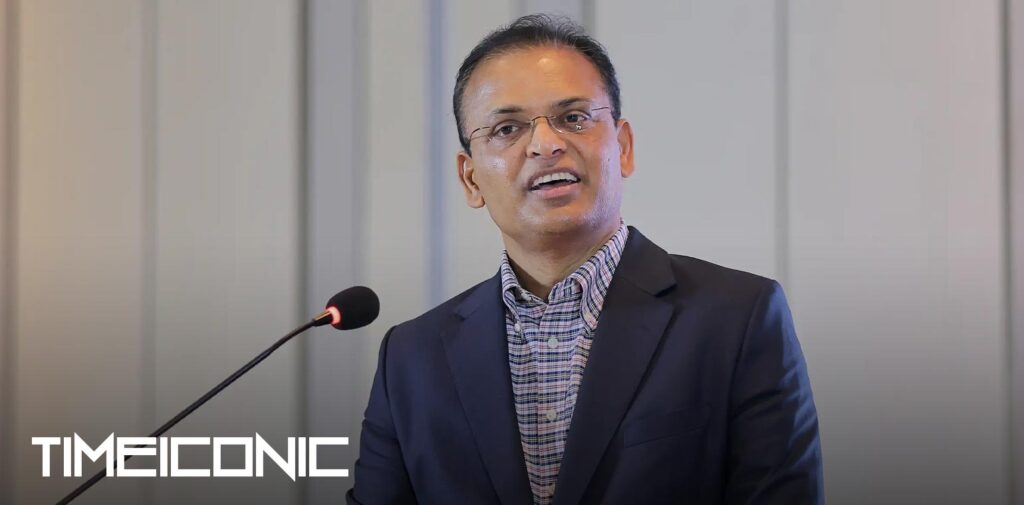
As Executive Vice President and Chief Human Resources Officer at Greif, Bala Sathyanarayanan has spent nearly two decades learning that the hardest part of leadership is not making decisions. It is creating the conditions in which other people can succeed.
The Journey Behind the Title
Bala Sathyanarayanan did not set out to become one of the most respected human resources leaders in global industrial manufacturing. He set out to be an engineer. That early training, with its emphasis on systems, structures, and the way individual components connect to produce a working whole, still shapes the way he thinks about organisations today. Somewhere along the way, his attention shifted from the machinery to the people who operate it.
His career since has taken him through some of the most recognisable names in global business. He built HR leadership experience across the Americas at Hewlett-Packard, led human resources and business transformation across large parts of the enterprise at Xerox, and gathered further experience at Coca-Cola and Avaya before joining Greif in 2018, where he now serves as Executive Vice President and Chief Human Resources Officer. Each stop exposed him to a different industry, a different culture, and a different set of business pressures, but the throughline was consistent.
“My interest increasingly turned towards the people within those systems, how they learn, earn trust, and develop the confidence to contribute,” he says, tracing the shift back to his earliest years on the job rather than to any single turning point.
That interest was sharpened by a deeply personal experience. Sathyanarayanan and his wife moved to the United States only a few months after their wedding, arriving with professional ambition but little certainty about how their two careers would take shape in a new country. They leaned on family, mentors, and colleagues who offered guidance and opportunity while they found their footing. It was a formative period, and it left him with a conviction that continues to guide how he evaluates talent decades later.
“A person’s current experience tells you something about their capabilities, but it does not tell you everything about their potential. Leadership includes recognising that potential and creating the conditions in which it can grow.”
That belief, that potential is often hidden beneath circumstance rather than absent altogether, has become one of the defining threads of his leadership philosophy. It shows up in how Greif approaches hiring, development, and the everyday decisions that determine who gets a chance to grow. It also explains why, across four very different companies and industries, colleagues consistently describe him the same way: as someone who asks more questions than he answers, and who treats every early conversation with a new hire as the beginning of a longer story rather than a single evaluation.
It is worth pausing on the breadth of that journey. Consumer goods, telecommunications, enterprise technology, and now industrial packaging each carry their own rhythms, their own risks, and their own definitions of what good leadership looks like. Sathyanarayanan has had to relearn, more than once, what motivates a factory floor supervisor compared with a regional sales leader or a corporate strategist. That repeated relearning, he suggests, is precisely what has kept his thinking sharp rather than settled.
The Engine Behind Execution
Sathyanarayanan is direct about the relationship between people strategy and business performance. For him, the two are not adjacent priorities that happen to intersect. They are the same conversation viewed from different angles.
“Workforce strategy determines whether a business has the capabilities to deliver its ambitions,” he says plainly, in the same matter-of-fact tone he tends to use for the ideas he considers most obvious once stated aloud.
A company, he points out, can assemble a compelling strategy, strong products, and good technology, and still fall short if its people do not understand their responsibilities, lack the skills to perform, or cannot work effectively across organisational boundaries. Execution, in other words, is a human outcome before it is a financial one.
This thinking has played out directly inside Greif, as the company has worked to shift from a product based business towards a broader solutions provider. That transition, Sathyanarayanan explains, has required the organisation to examine its operating model, redefine leadership responsibilities, and build new capabilities from the ground up. Standing up a marketing and communications organisation, he notes, is one visible example of translating business direction into the specific work people need to do.
He is equally attentive to the fact that a single workforce playbook cannot serve every part of a global manufacturer. A production facility, a corporate function, and a customer facing team each need a different kind of support, even when they operate under the same company values.
“Global principles provide consistency, while local decisions make those principles useful,” he explains, describing it as a balance he has had to relearn at every company he has worked for.
That balance between consistency and local judgement runs through Greif’s Build to Last strategy, where the people’s agenda is explicitly connected to customer service, operational excellence, safety, sustainability, and financial strength. The test Sathyanarayanan applies to any workforce decision is simple: does it make the organisation more capable of delivering on those priorities.
The Leader Who Learned to Listen
Ask Sathyanarayanan how his understanding of leadership has changed over the course of his career, and he does not reach for a polished formula. He talks instead about correcting his own instincts.
Earlier in his career, he placed considerable weight on direction, decision making, and measurable results. Those still matter to him. But he has come to pay far closer attention to how leaders create the conditions for others to succeed, a shift that came less from theory than from confronting his own shortcomings.
“Saying I valued different perspectives meant little if I became defensive when someone challenged me,” he admits, before adding, “listening required practice, particularly when I was tired, distracted, or under pressure. It still does.”
As his responsibilities expanded, so did the weight of his reactions. A leader’s response to an uncomfortable question, he has learned, often determines whether that colleague will choose to speak honestly the next time. That realisation has pushed him towards a leadership style built on ownership rather than control.
“The best leaders create ownership rather than dependence. They provide direction, information, and accountability while giving people room to exercise judgement.”
He is also candid about the discomfort of not having every answer, and increasingly comfortable admitting it. Colleagues, he argues, do not need a leader who pretends to know everything. They need someone willing to explain what is known, be honest about what remains unresolved, and take responsibility for moving forward regardless.
That same philosophy extends into how he thinks about the everyday experience of working at Greif. Purpose, clarity, respect, and opportunity form the foundation, he says, of a workplace where people feel genuinely valued rather than merely employed. Purpose has to be visible in decisions, including the difficult ones. Clarity removes the friction that ambiguity creates, even among the most committed teams. Respect means taking people’s views seriously and being willing to admit when something could have been handled better. And opportunity, in his view, does not always mean promotion. Sometimes it simply means the chance to learn a new skill, take on a meaningful project, or gain exposure to another part of the business.
“I want colleagues to feel safe, welcome, celebrated, and cherished,” he says, then pauses on the weight of those words before finishing the thought. “Those words carry an obligation. Our everyday decisions must give people reasons to believe them.”
The Real Test of Culture
Sathyanarayanan has a clear test for distinguishing an authentic culture from corporate messaging, and it has nothing to do with what is printed on a wall.
“Look at what happens when priorities collide,” he says, offering the line almost as an instruction rather than an observation.
If an organisation claims safety comes first but quietly rewards output regardless of how it was achieved, employees understand the real expectation instantly, whatever the posters say. The same logic applies to inclusion, or to any value that sounds good in a mission statement but disappears the moment it becomes inconvenient.
At Greif, that test is applied against the Greif Way, a shared framework built around being people focused, practising servant leadership, staying customer driven, maintaining an action bias, and pursuing Zero Harm, supported by foundational values that include being ethical, strong through diversity, serious about sustainability, and committed to continuous improvement. For Sathyanarayanan, the framework itself is only the starting point. The real evidence lies in the questions that follow. Who receives an opportunity? What happens when someone reports a mistake? Are managers held accountable for how they achieve results, not just whether they achieved them? Do promotion and reward decisions actually reinforce what the company says it values?
“Culture becomes durable when those systems and everyday choices support one another. Colleagues learn what matters by experiencing it repeatedly.”
This is where engagement becomes more than a survey score for Sathyanarayanan. He describes engagement as something that grows when colleagues see their voices genuinely influence what happens next, with the survey itself functioning only as the opening move in a longer conversation. At Greif, managers are supported in turning feedback into action through strengths coaching, structured conversation tools, and the company’s Engagement Champions Network, an approach built on a simple discipline: understand what colleagues are experiencing, agree on priorities, follow through, and when something cannot change immediately, explain why.
That discipline has produced results that are difficult to dismiss as coincidence. Greif has received Gallup’s Exceptional Workplace Award for three consecutive years, earning the additional distinction of Winner With Distinction in 2026. A published Gallup case study found that highly engaged teams at Greif recorded 42 percent fewer safety incidents and 7 percent higher customer satisfaction than their less engaged counterparts, a finding that reframes engagement as an operational lever rather than a soft metric. The company’s culture has also been recognised externally, with Greif named to Newsweek’s 2025 Top 100 Global Most Loved Workplaces and The Wall Street Journal’s 2025 America’s Top 100 Most Loved Workplaces.
“For me, these honours bring gratitude and responsibility,” he says, careful to spread the credit rather than claim it. “They recognise work that many people have contributed to, and they challenge us to keep earning our colleagues’ trust.”
He holds himself and every leader at Greif to one recurring question, deliberately simple in its phrasing but demanding in what it requires as an answer.
“What is better for our colleagues because we listened?” he asks. “We should be able to answer with something they can see and experience in their working day.”
The Price and the Promise of Ambition
For all his emphasis on performance, Sathyanarayanan speaks with unusual honesty about the personal cost that can accompany it. Sustainable performance, he argues, depends on people having the energy, capability, and support to deliver, but he is careful not to pretend that balance comes easily, particularly during transformation or periods of intense demand.
He draws on his own experience to make the point. In their early years in the United States, Sathyanarayanan and his wife spent roughly a year apart from their two sons, who were cared for by family in India while the couple worked to establish their careers. It is a story he does not tell for effect.
“They were loved, but the separation was deeply painful,” he says quietly, before adding, “I cannot turn that experience into a simple lesson about ambition and success.”
What it has given him instead is a lasting reminder that every colleague carries responsibilities beyond what a manager can see across a desk or a screen. Practically, he pushes leaders to interrogate their own demands on people rather than assume commitment can simply absorb them: what can be stopped or simplified, where additional support is genuinely needed, and whether teams are being asked to sustain an exceptional workload indefinitely without acknowledgement.
Development, in his view, cannot be treated as an afterthought squeezed into an already full workload. Coaching, mentoring, and new assignments need to be planned deliberately, with the same seriousness applied to quarterly targets. High expectations remain non negotiable for him, but so does the responsibility to understand honestly what meeting them actually asks of people.
That same honesty carries into how he thinks about attracting and keeping talent. Reputation may bring candidates to the door, he says, but it is lived experience that determines whether they stay.
“Attraction begins with reputation, but retention is driven by experience,” he says, delivering the line like a rule he has tested many times over.
At Greif, that philosophy has translated into a global pay transparency initiative designed to give colleagues greater clarity about the principles and practices guiding compensation decisions, without disclosing individual pay figures. It reflects his broader belief that trust is built less by grand gestures than by helping people understand how decisions that affect them are actually made. He is equally insistent that career growth cannot follow a single track. Some colleagues want leadership responsibility. Others want to deepen technical expertise or broaden their experience across functions. Internal movement and meaningful assignments, he says, need to accommodate both ambitions rather than funnel everyone towards the same definition of success.
“People should not have to guess whether anyone is interested in their future. Managers need to make that interest tangible through regular career conversations and practical support.”
This conviction extends naturally into how he views inclusion and belonging, which he treats as a direct accountability of senior leadership rather than a delegated function. Representation matters, he says, but so does the lived experience of being part of the organisation, including whether colleagues have genuine access to development, fair assessment, and the confidence to raise concerns without fear. He pushes leaders to examine their own assumptions about what a successful candidate or leader looks like, and to accept that those assumptions are often narrower than they realise. At Greif, this thinking sits under the foundational value of Strong Through Diversity, which he describes not as a statement but as a practice of creating room for different perspectives to shape decisions, and of holding leaders accountable for respectful behaviour and consistent standards.
“Belonging grows when people can see that their contribution is taken seriously,” he says, closing the thought the way he closes most of his answers, without embellishment.
Building for What Comes Next
As technology and artificial intelligence reshape the nature of work, Sathyanarayanan believes the role of senior workforce leaders is entering a period of real change, one that will demand a far deeper understanding of how these tools affect tasks, capabilities, and the design of organisations themselves. He resists treating technology adoption as an end in itself, insisting that every application be evaluated against a clear purpose, whether that is improving colleague service, organising information, supporting learning, or reducing repetitive administrative work.
He is particularly deliberate about where the stakes are highest. Where a system influences someone’s employment or access to opportunity, he insists that accuracy, privacy, fairness, and meaningful human review require particular attention, with accountability remaining clearly assigned rather than diffused across a process.
“The CHRO also has a responsibility to help colleagues navigate the transition. Introducing technology is only one step. People need to understand how their work may change, what skills they will need, and what support will be available.”
Looking at his own priorities as EVP and CHRO today, Sathyanarayanan groups them into three connected areas. The first is leadership effectiveness, built around leaders who practise servant leadership, set clear expectations, make sound decisions, and develop the people around them. The second is capability and readiness, understanding which skills are becoming more important as Greif pursues transformation and operational excellence, where the gaps exist, and how development, hiring, and internal movement can close them. The third is the quality of the colleague experience itself, spanning engagement, career opportunity, pay clarity, wellbeing, and belonging.
“The aim is an organisation better prepared to serve customers, meet its commitments, and offer colleagues meaningful opportunities,” he says, summing up three years of priorities in a single breath.
Underlying all of it is servant leadership, a principle he describes as especially important because it turns leadership into a practical responsibility rather than an abstract quality. It asks leaders to understand what their teams genuinely need, remove obstacles standing in their way, provide honest guidance, and help others grow more capable over time. The Greif Way gives that responsibility a shared foundation across the organisation, while the company’s engagement resources and Engagement Champions Network help managers listen and respond with more consistency.
For Sathyanarayanan, this commitment is rooted in something deeply personal. His wife was building her own career alongside his. Their parents helped raise their children across continents. Mentors opened doors, colleagues challenged his thinking, and teams placed their trust in him long before he had proven he deserved it.
“Whatever people associate with my career, many others helped make it possible,” he says, without any of the reluctance that usually accompanies that kind of admission.
That gratitude has become the engine behind everything he now tries to build at Greif. He hopes colleagues will remember not only what the organisation achieved together, but how they were treated while achieving it, a distinction he considers far from incidental.
“It took a village. It still does,” he says, before landing on the line that seems to explain everything else he has said. “The responsibility I feel now is to be part of that village for someone else.”
It is a fitting way to sum up a career that began with an engineer’s instinct for how systems fit together, and has arrived at a conviction that the most important system any leader will ever build is made entirely of people. In an era when workforce strategy is increasingly discussed in the same breath as automation, efficiency, and quarterly output, Sathyanarayanan remains focused on a quieter and more durable question: whether the people inside an organisation are better off, more capable, and more trusted than they were the day before. It is a standard that resists shortcuts, and one he seems entirely comfortable being measured against.
