
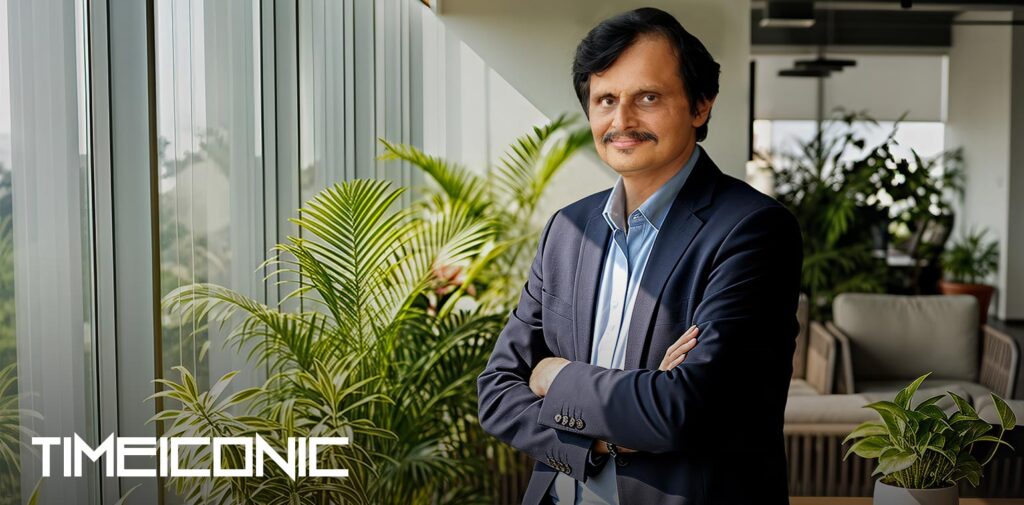
In a small trading office in Bangalore in the late 1990s, a young chemist was quietly walking away from a career that most people would have considered secure. Shyamprasad Kodimule had spent more than four years inside the pharmaceutical industry, formulating active pharmaceutical ingredients and watching synthetic chemistry turn raw material into medicine. It was steady work. It was also, he realized, not where he belonged.
Today, that decision looks less like a risk and more like foresight. Shyamprasad is the Founder and President of VIDYA Group, a company that has grown from a one-man trading venture into a multinational manufacturer of botanical extracts, biotics, and specialty ingredients, with operations spanning more than a dozen manufacturing facilities in India and abroad, including a dedicated extraction and formulation base in Florida. The company today serves the nutraceutical, pharmaceutical, food and beverage, and personal care industries across several continents, built on a philosophy that Shyamprasad has repeated so often inside his own organization that it has become something close to scripture: nature meets science.
This is the story of how a chemist who grew tired of synthetic reactions built one of India’s most recognized natural ingredients companies, and why he believes the next decade of growth will be won not on marketing claims, but on laboratories, dossiers, and data.
The Making of a Natural Chemist
Shyamprasad’s professional life began in a conventional enough place. After completing his master’s degree in chemistry, he joined a pharmaceutical company, where his job was to synthesize active pharmaceutical ingredients. It was technical, demanding work, and for four and a half years, it paid the bills and sharpened his fundamentals in organic chemistry. But the daily routine of working with chemicals and synthetic reactions gradually convinced him that this was not the field he was meant to build a career in. Something about the work, however capable he was at it, left him feeling that his real interests lay elsewhere.
The pull toward natural products had actually started earlier, during the final year of his master’s degree, when he chose to write his dissertation on natural compounds rather than synthetic ones. That academic detour turned out to be formative. Long after he had left the classroom, curiosity stayed with him, quietly building a case for a different kind of career, one centered on the molecules nature had already perfected rather than the ones a laboratory could assemble from scratch.
Leaving a stable job in his mid-twenties to chase an idea in a largely unorganized industry was not an easy call. There was no company waiting for him on the other side, no natural products employer eager to hire a pharmaceutical chemist. So he decided to build the opportunity himself.
“I was looking for a job in that area, or I would create a job for myself, for my own business. So instead of a job, I created my enterprise,” he says, describing the moment with the same matter-of-fact tone he uses for most of his biggest decisions.
He started small, trading herbal extracts and botanicals, buying finished material from other manufacturers and exporting it to buyers overseas. It was not glamorous work, but it gave him something more valuable than early profit: proximity to the industry he wanted to build in. Shyamprasad spent this period visiting research laboratories and libraries, studying the phytochemistry of leaves, plants, fruits, and secondary metabolites, trying to understand the compounds nature had engineered long before any pharmaceutical company existed. The subject fascinated him enough that it shaped much of how he would later approach product development, as a continuous process of discovery rather than a fixed catalog of extracts. That immersion, part business and part obsession, eventually gave him the confidence and the capital to take the next step.
With the money earned through trading, he set up a small manufacturing facility in Bangalore on a modest plot of land. It was an unassuming beginning for what would eventually become a company operating across continents, but it marked the real starting point of Vidya Herbs as a manufacturer, not just a trader of other people’s products.
A Quality-First Philosophy From Day One
Ask Shyamprasad what separates Vidya Herbs from the hundreds of other players in the natural ingredients space, and he does not talk about scale first. He talks about science. As a chemist by training, his instinct has always been to lead with a quality-first policy and to ask, for every product the company develops, what would genuinely set it apart from what already exists in the market.
That instinct has shaped how the company has been built internally. Vidya now employs a scientific team of fifty to sixty researchers who work full time on ingredient development, safety evaluation, and toxicity assessment. Every extract that leaves the company’s facilities is backed by a dossier, a documented body of evidence covering its composition, safety profile, and quality parameters. The company operates an NABL accredited laboratory for quality control, a distinction that matters in an industry where claims are often easier to make than to prove.
For Shyamprasad, this focus on quality did not arrive later as the company scaled. He describes it as something closer to instinct than policy, a standard he applied to the very first product Vidya ever brought to market and has never revisited since. It grew out of a simple, unavoidable reality: the raw material itself comes from agriculture, which means it carries the inherent variability of farms, weather, and soil, along with the risk of pesticide residues and contamination. Every batch has to be checked, and every extract has to be guaranteed safe before it reaches a customer’s formulation. A company that sources from nature, he argues, carries a responsibility that a purely synthetic manufacturer does not, because there is no room to sell an extract on the strength of a good story if the underlying science does not hold up.
“We want the product to speak for itself, rather than build a story around it. That is where we invest, in science and in the technology of extraction,” he says, describing an approach that runs counter to the more marketing-driven playbook many botanical brands have relied on.
That guarantee has come at a real financial cost. Vidya has invested several million dollars into quality control laboratories and the specialized instruments and personnel required to run them, a level of infrastructure spending that is unusual for a company that began life as a small trading outfit. Industry observers have taken note of this positioning. Vidya’s turmeric extract innovation, Puremeric Stain Free Technology, won a Gold Innovation award at the International Spice Conference in 2019, recognition for a product developed specifically to solve a practical formulation problem rather than to chase a trend. It is the kind of accolade that fits neatly into Shyamprasad’s broader thesis, that natural ingredients backed by rigorous science, not storytelling, are what the market will ultimately reward, and that the natural products industry as a whole is still catching up to the level of scientific evaluation that categories like pharmaceuticals have long taken for granted.
Building Where the Customer Stands
Vidya’s expansion beyond India has followed a deliberate logic that Shyamprasad articulates with unusual clarity for a founder describing his own strategy. The company is headquartered in Bangalore and operates the majority of its manufacturing base in India, but it has steadily built a footprint across other geographies as well, including the United States, where it runs a supercritical fluid extraction facility in Bunnell, Florida, alongside a dedicated probiotic formulation unit at the same site.
The decision to manufacture inside the markets Vidya serves, rather than simply exporting finished goods from India, was intentional. Shyamprasad’s thinking has always leaned international, driven by a need to stay close enough to customers in major markets that they feel genuinely supported rather than served from a distance.
“We want to be made in that country, not just made in India and exported to the USA. We want to produce there, so that we carry a different image altogether, not only as Indian producers, but as a company with real production capability in the countries we serve,” Shyamprasad explains.
That image matters more than it might first appear. For customers in regulated industries like nutraceuticals and pharmaceuticals, proximity to manufacturing often translates into faster turnaround, easier regulatory alignment, and greater confidence in supply chain continuity. By establishing local production rather than relying purely on exports, Vidya has positioned itself less as an Indian exporter serving the world and more as a genuinely multinational manufacturer with an Indian scientific core. Shyamprasad also frames this expansion as a form of local economic participation, a way of contributing to the societies Vidya operates in rather than simply extracting value from them. This global build-out has not come at the expense of the company’s Indian roots. If anything, India remains the center of gravity for both raw material sourcing and large-scale manufacturing, a reflection of the country’s deep botanical biodiversity and Vidya’s long-standing farmer relationships.
The Turning Point
Every founder’s journey tends to have a moment that, in hindsight, changes the trajectory of the company. For Shyamprasad, that moment is unfolding right now, in the form of a 20,000 tons instant coffee manufacturing facility built in India, a project he describes without hesitation as a turning point for the business.
What makes the project significant to Shyamprasad is not simply the scale of production, but where it has been located. The facility sits in a rural part of India where manufacturing infrastructure has historically been scarce, and it is designed to employ and train local workforce rather than draw people toward the country’s already congested cities.
“We are generating employment in a rural sector where there were no manufacturing facilities before. We train people and give them work close to home, so that they get employment rather than having to migrate to the cities. We want to create work for the people right there,” he explains.
The second pillar of this turning point is research and development. Vidya operates a standalone R&D facility in Bangalore, established in 2015, which Shyamprasad refers to as the company’s center for excellence. It is here that the company’s phytochemistry department develops new natural extracts, standardizes them, and puts them through scientific evaluation, including docking studies, before moving toward clinical research. Shyamprasad places significant personal weight on this facility, describing its construction as one of the defining investments of his tenure, precisely because it is the engine that will produce the patented and trademarked ingredients that differentiate Vidya from competitors relying on more generic extracts. The R&D center has been recognized by India’s Department of Scientific and Industrial Research, a government body that certifies in-house research infrastructure, further validating Vidya’s claim to being a science-led rather than trade-led organization. Together, the coffee facility and the R&D center represent two different but complementary bets: one on manufacturing scale and rural employment, the other on the intellectual property that will define Vidya’s next generation of products.
People Over Machines
For a company built on laboratories, instruments, and manufacturing infrastructure, Shyamprasad is surprisingly insistent that none of it is the real asset.
“Manpower is what matters most to me, not machines or equipment. The people in this company, the workforce, are the most important part of it,” he says.
As Vidya has grown from a single facility into a company with manufacturing units across multiple countries, Shyamprasad’s approach to leadership has centered on cultivating a sense of ownership among employees rather than simply managing a larger headcount. He believes that when an employee begins to think of the company as their own, something they are personally invested in building rather than simply working for, the results the business produces change entirely. Building that kind of team has become one of his central preoccupations as a leader, more so than any operational or financial metric. It is a philosophy he describes less as a formal program and more as a mindset he tries to instill through daily engagement with his teams, motivating people to see themselves as stakeholders in the company’s outcomes rather than employees executing instructions.
Despite having spent decades building the company, Shyamprasad says his own appetite for new ideas has not diminished. Even after years in the business, he still describes himself as full of passion for creating new concepts and pushing the company into fresh territory. That restlessness is now pointed at food and beverage value addition, an area he sees as a natural extension of Vidya’s ingredient expertise, with significant opportunity ahead in supplement-based functional beverages and functional foods, categories he believes will require considerably more focused work from the company in the years to come.
Sustainability as a Business Fundamental
For a company whose entire raw material base comes from agriculture, sustainability is not an optional corporate initiative for Vidya. It is embedded in the supply chain itself, running from farmer to factory and back to the customer. Shyamprasad describes sustainability and traceability as issues the company treats with real seriousness rather than as a compliance checkbox, and Vidya maintains detailed documentation around sourcing to support that claim. The company has also been investing in green energy initiatives aimed at reducing its environmental footprint, an effort Shyamprasad sees as directly tied to how responsibly the business is able to operate going forward.
Waste management, in particular, is treated as an opportunity rather than a cost center. Rather than simply disposing of byproducts, the company has been exploring ways to convert waste into usable energy or value, an approach often described in the industry as waste to wealth, and Shyamprasad considers this one of the fundamental points on which Vidya’s environmental practice rests.
This commitment extends beyond environmental practice into direct social investment in the rural communities where the company operates. Vidya has built a hospital that provides free treatment to patients in a rural area, with a second hospital currently under construction. The company has also funded the construction of a school designed to serve around fifteen hundred children in a rural setting, alongside programs that support girls’ education specifically, an area Shyamprasad considers particularly important to the company’s broader social contribution.
“Business is like two wheels. One wheel is doing business, and the other is giving back to society,” Shyamprasad says, framing corporate social responsibility not as a separate obligation but as a structural half of how the company operates.
A Legacy Measured in Decades
If there is a single idea that Shyamprasad returns to more than any other across the arc of his career, it is the distinction between spending on science and investing in it.
“Invest in science. It is not an expense, it is an investment, in science, in people, and in R&D, in how we bring out new ingredients,” he says.
This principle plays out in how Vidya validates its products before they reach customers. Shyamprasad is emphatic that no product should ever go to market without evaluation, a philosophy that extends beyond the company’s internal laboratories. Vidya engages external contract research organizations to run clinical evaluations across different geographies, testing products independently before they are handed to customers for incorporation into their own supplements and formulations. Combining internal quality control with outward-facing clinical validation, he believes, is what allows Vidya to meet the exact specifications customers are looking for rather than offering a generic extract and hoping it fits.
Looking ahead, Shyamprasad identifies healthy aging as one of the categories where he expects consumer demand and scientific validation to increasingly converge. As global populations age and consumers grow more sophisticated about what they put into their bodies, he sees genuine momentum building around supplements designed to support aging well rather than simply treating illness, products aimed at helping people lead longer, healthier lives with a better quality of life overall. It is a category he speaks about with evident personal satisfaction, describing the ability to contribute to that kind of outcome as one of the most rewarding parts of being in this business.
When asked what he ultimately wants his company and his leadership to be remembered for, Shyamprasad does not reach for a number or a market share figure. He reaches for a word: TRUST. He wants Vidya to be remembered as a company that created something second to none in the natural products sector, one that left a lasting mark on the industry and built a reputation around products that are genuinely one hundred percent natural, scientifically validated, and clinically tested. That ambition, he says, is not just about products but about building value within the company and within the wider society it operates in. That long view extends into how he thinks about customer relationships as well, built deliberately around multi-year horizons rather than short-term wins.
“I always think of business as a long-term plan. I don’t believe in spot business. Even when we develop a customer relationship, I think about what it looks like five years from now, ten years from now, and beyond,” he says.
For Shyamprasad, the fundamentals that built Vidya Herbs are the same ones he believes any entrepreneur needs to succeed in a difficult, unglamorous industry: dedication, application, and passion, backed by full commitment to the work rather than a search for shortcuts. He speaks of business as requiring two hundred percent effort behind a dream, and describes quality itself as inseparable from that commitment, not a separate pillar but a natural consequence of doing the work properly. More than two decades after he walked away from a stable pharmaceutical career to bet on natural chemistry, that conviction has only hardened. Vidya Herbs has grown into a company with manufacturing operations spanning multiple continents, a scientific workforce in the dozens, and a rural social footprint that includes hospitals and schools. But the philosophy that started it all remains unchanged: quality first, science over storytelling, and a belief that nature, properly understood, can outperform anything synthesized in its place.
“Where nature meets science,” Shyamprasad says, summing up in five words what has taken him more than twenty-five years to build, “is the destination for Vidya.”
