
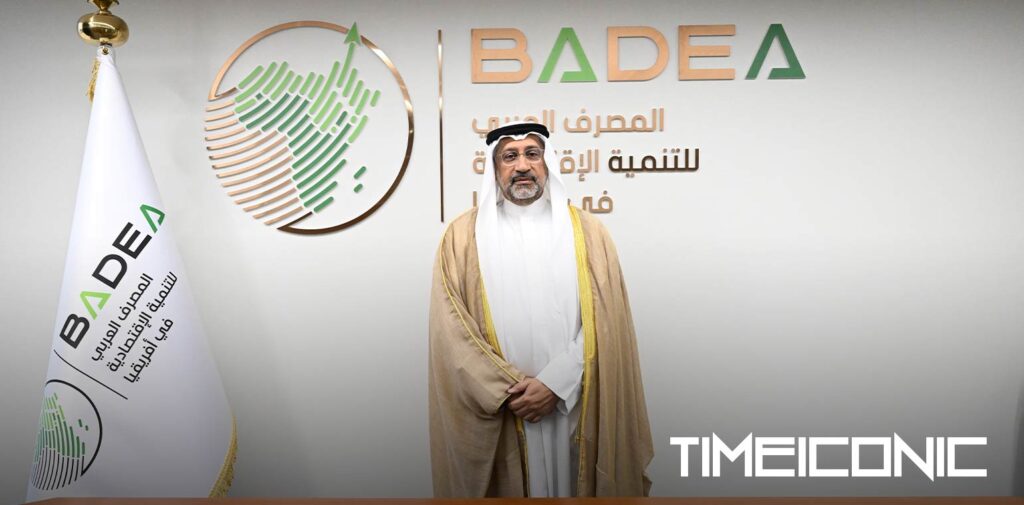
In the corridors of development finance, where institutions often measure themselves in disbursement figures and portfolio size, Abdullah KH ALMUSAIBEEH speaks a different language. He talks about trust. He talks about listening. He talks about roads that are never just roads and loans that are never just loans. As President of the Arab Bank for Economic Development in Africa (BADEA), ALMUSAIBEEH leads an institution that has spent more than five decades acting as a connective tissue between two regions bound by geography, history, and an increasingly shared economic future.
BADEA was founded in 1975 to deepen economic, financial, and technical cooperation between Arab countries and Sub-Saharan Africa. Today, carrying an AA+ rating from Moody’s and S&P, the Bank has grown into a multilateral development finance institution whose reach extends across transport, energy, water, agriculture, digital connectivity, healthcare, education, and trade. Its role, as ALMUSAIBEEH describes it, extends far beyond writing checks. The Bank helps governments, financial institutions, and private-sector actors access the capital and expertise needed to invest in the sectors that drive long-term growth, and in doing so it supports economic diversification, regional integration, job creation, and rising living standards across the continent.
But numbers alone do not explain how ALMUSAIBEEH thinks about the institution he now leads. To understand that, it helps to trace the path that brought him here, and to sit with the convictions he has carried through more than three decades in the field.
A Journey Built on Listening
ALMUSAIBEEH’s career in development finance began in 1993, when he joined the Kuwait Fund for Arab Economic Development. Over the following decades, he rose through a series of senior roles, serving as Regional Director for Asia and the Pacific, Latin America and the Caribbean, and Arab countries, before becoming Deputy Director of Operations and eventually Director of Operations. It was a path that took him across continents and development contexts, and one that quietly prepared him for the role he holds today.
“These roles gave me the opportunity to work across diverse regions, understand different development contexts, and contribute to initiatives designed to generate sustainable economic and social impact,” he says, reflecting on those years. Alongside his work at the Kuwait Fund, he sat on the boards of several Arab and international development institutions, including BADEA’s own Board of Directors, an experience that gave him what he describes as a close understanding of the Bank’s mission and its distinctive role in strengthening Arab-African cooperation. The move to the presidency, he says, felt less like a career change and more like a natural continuation of the work he had already been doing.
What has sustained his commitment to this field, he explains, is not abstract policy but visible transformation. He speaks of watching a project evolve from an idea into a functioning road, hospital, water system, or trade corridor, and of the sense of purpose that comes from seeing capital translate into something communities can actually use. Over time, his understanding of what development finance should achieve has shifted. Where he once viewed his work primarily through the lens of financing individual projects, he now sees it as part of a much larger process of economic transformation, one where capital matters but where institutions, local ownership, and knowledge exchange matter just as much.
That shift in perspective has shaped how he talks about Africa itself. Rather than framing the continent as a recipient of aid, ALMUSAIBEEH describes it as a partner whose own strengths should drive its development path. “Africa’s development must be driven by its own priorities and considerable strengths,” he says, pointing to the continent’s young population, its natural resources, and its expanding markets as assets rather than challenges to be managed. In his view, BADEA’s task is not simply to finance projects but to serve as a long-term partner that helps countries mobilize investment, build productive capacity, and pursue growth that is inclusive and resilient.
Beyond his role at BADEA, ALMUSAIBEEH continues to serve on the boards of several major regional institutions, including the African Export-Import Bank, the Eastern and Southern African Trade and Development Bank Group, the West African Development Bank, and the Development Bank of the Central African States. He is also a member of the Heads of the Arab Coordination Group. These engagements, he says, keep his perspective broad and reinforce his conviction that close regional and international cooperation is essential to advancing development that is both sustainable and inclusive. Taken together, his career reads less like a single ascent and more like a widening circle, one that has steadily brought him closer to the institution he now leads and the region it was built to serve.
The Architecture of Transformation
If there is a single idea that runs through ALMUSAIBEEH’s vision for BADEA, it is that development sectors cannot be treated in isolation. When he considers which industries will shape Africa’s economic trajectory over the next decade, he lays out a web of interconnected priorities rather than a single answer. Energy, in his view, is foundational, since reliable and increasingly sustainable power underpins industrialization, digital services, and modern agriculture alike. Transport and trade infrastructure follow closely behind, with better roads, ports, and border systems needed to connect producers to markets and lower the cost of doing business across the continent.
Agriculture and agro-industry round out that picture, with ALMUSAIBEEH describing a full value chain approach that spans irrigation, storage, processing, and market access, so that more value is created and kept within African economies rather than exported as raw material. Digital technology and financial services, he adds, act as accelerators across all of these sectors, expanding financial inclusion and enabling businesses to compete at scale. None of it works, he insists, without sustained investment in people. “Africa’s young population is one of its greatest assets, and empowering young people with the capabilities to innovate, produce, and lead will ultimately determine the continent’s success,” he says.
This integrated thinking is embedded in BADEA’s own strategic framework. Through its BADEA 2030 Strategy, the Bank organizes its work around four connected pillars: infrastructure development, agricultural value chains, trade and private-sector development, and support for small and medium-sized enterprises. These priorities are deliberately aligned with the United Nations Sustainable Development Goals and the African Union’s Agenda 2063, reflecting an institutional commitment to growth that is inclusive and environmentally sustainable rather than growth for its own sake.
Trade and private-sector development have become an increasingly central part of that work. BADEA provides liquidity, guarantees, and risk-sharing mechanisms designed to help businesses and financial institutions overcome market constraints, supporting exporters, importers, local banks, and entrepreneurs in the process. Infrastructure remains the starting point for much of this activity, but ALMUSAIBEEH is careful to explain that the Bank does not think of a road as merely a road. A transport corridor, he notes, is really part of a wider effort to connect farmers to markets, reduce trade costs, and stimulate private investment along its entire length.
Partnership sits at the center of how this strategy gets executed. “No single institution can meet today’s development challenges alone,” ALMUSAIBEEH says, describing a model in which governments provide direction and regulatory stability, development finance institutions bring patient capital and technical expertise, and the private sector contributes innovation and operational scale. When these actors work well together, he argues, they distribute risk more sensibly, close financing gaps, and speed up the delivery of high-impact projects. But he is equally clear that partnerships only succeed when they are built on transparency and trust, and when they deliver measurable benefits for communities rather than focusing narrowly on financial return.
Digital innovation has become one of the more forward-looking pieces of that partnership model. ALMUSAIBEEH describes digital tools as addressing three persistent development challenges at once: access, efficiency, and accountability. Mobile and digital platforms are already extending banking services to people who previously had none, while satellite imagery, mobile reporting, and cloud-based project management now allow institutions like BADEA to track implementation in near real time rather than waiting for periodic field visits. Looking further ahead, he points to the emergence of Digital Public Infrastructure, built on digital identity, digital payments, and consent-based data exchange, as a trend that could be especially transformative for Africa by bridging gaps between urban and rural populations. Artificial intelligence, he adds, is already beginning to reshape how development institutions assess risk, detect fraud, and measure impact, moving the sector away from reliance on historical reports and toward real-time, data-driven decision-making.
ALMUSAIBEEH is careful to distinguish BADEA from the broader field of international financial institutions, and the distinction he draws has less to do with size than with philosophy. BADEA, he explains, was created specifically to strengthen economic cooperation between the Arab world and Africa, which means its mission extends beyond lending money into the harder work of connecting capital, expertise, and investment opportunity across two regions. In practice, that often means mobilizing additional partners rather than financing projects alone, and using the Bank’s convening power to bring governments, development finance institutions, and private investors to the same table.
That philosophy extends to how BADEA approaches the countries it works with. Its strategic framework was built through consultations with African stakeholders and is explicitly aligned with beneficiary-country priorities, the United Nations Sustainable Development Goals, and the African Union’s Agenda 2063. ALMUSAIBEEH resists the idea of a single template applied uniformly across the continent. “BADEA believes development is most effective when it is country-led,” he says. “Our role is not to impose solutions, but to support nationally defined priorities with financing, expertise, and partnerships tailored to local circumstances.” Success, in this framing, is measured less by the number of projects approved and more by whether the underlying economic transformation actually took hold.
This is also where BADEA’s emphasis on human capital and local ownership becomes central to its identity. Infrastructure alone, ALMUSAIBEEH argues, cannot deliver sustainable development without corresponding investment in people, which is why the Bank prioritizes education, vocational training, healthcare systems, and institutional capacity building alongside its physical projects. A vibrant private sector, supported through access to finance and encouragement of entrepreneurship among women and youth, generates the jobs and innovation that infrastructure alone cannot. And regional integration, particularly through cross-border transport corridors and trade finance aligned with the African Continental Free Trade Area, allows individually small economies to access larger markets and benefit from economies of scale.
ALMUSAIBEEH describes these elements, infrastructure, private-sector growth, human capital, and regional integration, as reinforcing one another rather than operating in parallel. A new road corridor, in his account, does more than move goods. It allows farmers and manufacturers to reach markets more efficiently, which lets businesses along that corridor expand and hire more workers, which in turn increases demand for the education and healthcare that keep those workers productive. Cross-border connectivity then lets those same goods and services move freely between countries. “The result is a virtuous cycle of investment, productivity, job creation, and rising incomes that contributes to long-term economic transformation,” he says. It is a philosophy that treats development not as a series of discrete transactions but as an interconnected system, one that only works when every part of it is built with the others in mind.
Leadership Forged in Uncertainty
ALMUSAIBEEH’s account of his own leadership style is grounded less in theory and more in lived experience. The values that have guided him throughout his career, he says, are integrity, respect, humility, responsibility, and a commitment to service, and he links these directly to the weight of the decisions development finance requires. “In development finance, decisions affect institutions, economies, communities, and future generations,” he says. “It is therefore essential to act transparently, uphold the highest professional standards, and remain accountable for both the choices we make and the results we achieve.”
Working across dozens of countries and institutional cultures, he says, taught him that effective leadership begins with listening rather than prescribing. Every country carries its own history and its own way of working, and he believes a leader’s task is to approach those differences with openness rather than assuming a single model fits every context. He also speaks candidly about the limits of top-down decision making, arguing that the best outcomes emerge when people with different expertise and perspectives are encouraged to contribute honestly, and when colleagues feel trusted enough to take responsibility themselves.
That philosophy was tested most directly during a period of global uncertainty, when countries across BADEA’s partner regions faced simultaneous health, economic, and fiscal shocks. Projects had to keep delivering essential services even as supply chains broke down and governments confronted difficult tradeoffs between competing priorities. ALMUSAIBEEH describes the period as one that challenged the assumption that sound planning alone is enough to guarantee results. “Leadership in uncertain times requires both decisiveness and humility,” he reflects, “decisiveness to protect the institution’s mission and respond quickly, and humility to recognize that circumstances are evolving and that no leader has all the answers.”
That experience reshaped his approach to risk as well as to leadership itself. Rather than treating risk as something to avoid or ignore, he came to see it as something that must be understood, shared appropriately, and managed with discipline, distinguishing carefully between what could be postponed and what was essential to protect. Three lessons endure from that period, he says. He now places greater emphasis on institutional resilience, built on strong systems and clear lines of responsibility. He encourages open communication so problems surface early rather than late. And he tries to combine speed with sound judgment, anchoring urgent action in evidence and accountability rather than instinct alone. “Leadership is not about projecting certainty when uncertainty is unavoidable,” he says. “It is about providing clarity of purpose, creating confidence, and enabling people to act with courage and responsibility.”
That same instinct for reading structural change shapes how ALMUSAIBEEH talks about the future of development finance more broadly. He identifies four trends he expects to define the coming decade. Climate resilience, once treated as a separate environmental concern, is increasingly central to investment decisions themselves, as droughts, floods, and extreme weather directly threaten infrastructure, agriculture, and fiscal stability across developing economies. South-South cooperation is expanding as countries across Africa, the Gulf, Asia, and Latin America partner directly with one another rather than relying primarily on traditional North-South relationships, a shift he sees as particularly relevant to BADEA’s own mandate of strengthening Africa-Arab ties. Blended finance, combining concessional capital with commercial investment, is becoming the primary mechanism for closing the vast gap between development financing needs and the resources available from governments and traditional institutions alone. And digital transformation continues to reshape not just how services are delivered but how economies function and how institutions engage with the people they serve.
Looking at what stakeholders should expect from BADEA in the years ahead, ALMUSAIBEEH returns to the same interconnected framework, but with a sharper focus on the priorities he believes will define the next chapter. Infrastructure remains the anchor, spanning transport corridors, energy generation and transmission, water and sanitation systems, and the digital networks that allow countries to participate in a modern economy. Climate adaptation runs alongside it as both a development and an economic priority, given how exposed African economies are to droughts, floods, and extreme weather despite contributing relatively little to global emissions. BADEA has already backed initiatives such as the Alliance for Green Infrastructure in Africa, which aims to mobilize significant private capital for climate-resilient infrastructure across the continent, a signal of how central climate considerations have become to the Bank’s broader investment thinking.
Food security occupies a similarly prominent place in that outlook. ALMUSAIBEEH describes a shift underway across the continent, from simply increasing agricultural output to building competitive agricultural industries capable of creating jobs and strengthening resilience, through investment in irrigation, storage, agro-processing, and market access for farmers. Private-sector development remains the engine behind much of this, since public resources alone cannot meet Africa’s financing needs. The goal, as he puts it, is a gradual shift from aid-dependent growth toward investment-driven growth, powered by competitive businesses and deeper regional markets.
None of this, in ALMUSAIBEEH’s view, can be achieved through traditional project financing alone. He points instead to a broader shift already underway across the development finance industry, from financing individual projects toward mobilizing entire ecosystems of finance, blending guarantees, concessional capital, and commercial investment to draw private capital into markets it might otherwise avoid. For an institution like BADEA, he suggests, success in the coming years will increasingly be measured not only by how much the Bank finances directly, but by how much additional capital its involvement helps attract into Africa’s economic transformation.
A Legacy Measured in Lives
For all the strategic detail ALMUSAIBEEH brings to questions about sectors and financing instruments, his thoughts on legacy return, almost instinctively, to people. His advice to young professionals hoping to build careers in international development does not begin with technical skill. He begins with curiosity, describing it as the foundation of effective development work in a field constantly reshaped by technological change, demographic shifts, and climate pressure. He pairs that with adaptability, noting that institutions increasingly operate amid economic shocks, geopolitical tension, and public health crises that no amount of planning can fully anticipate.
He is equally direct about the limits of technical expertise on its own. Real impact, he argues, comes from combining financial and analytical skill with cultural awareness, empathy, and resilience, qualities that allow professionals to understand local realities rather than impose solutions from outside. Leadership skills matter just as much as analytical ones, he adds, since building consensus among governments, investors, and communities requires a different muscle than evaluating a balance sheet. Above all, he urges young professionals to hold onto a sense of purpose that outlasts any single job title. “Success is not measured solely by titles, promotions, transactions completed, or projects financed,” he says. “Rather, it is measured by the positive and lasting impact created for communities and future generations.”
That same standard is the one he applies to himself when he reflects on how he hopes to be remembered. He is quick to reject the idea that his legacy should be measured by positions held or achievements recorded. Instead, he frames it around institutional strength and human opportunity, whether BADEA becomes more capable and self-sustaining over time, whether more people, particularly women, youth, and rural communities, gain real access to opportunity, and whether the African economies BADEA works with emerge more resilient and prosperous in the years ahead. “Leadership is temporary, but institutions, human capital, and development impact can endure for generations,” he says.
That sentiment captures something essential about how ALMUSAIBEEH approaches the presidency of BADEA. He speaks less like an executive defending an institution’s balance sheet and more like a custodian of a longer relationship between two regions, one built gradually over five decades and intended to outlast any single leader’s tenure. Under his guidance, BADEA continues to describe itself not merely as a financing institution but as a bridge, mobilizing capital, expertise, and partnerships to help African countries pursue development on their own terms. “True leadership is about creating conditions for others to succeed,” he says, summarizing a philosophy that runs through nearly everything else he has to say. If that philosophy continues to guide BADEA’s next chapter, the Bank’s influence across Africa and the Arab world seems likely to be measured less in the size of its balance sheet and more in the durability of what it leaves behind.
